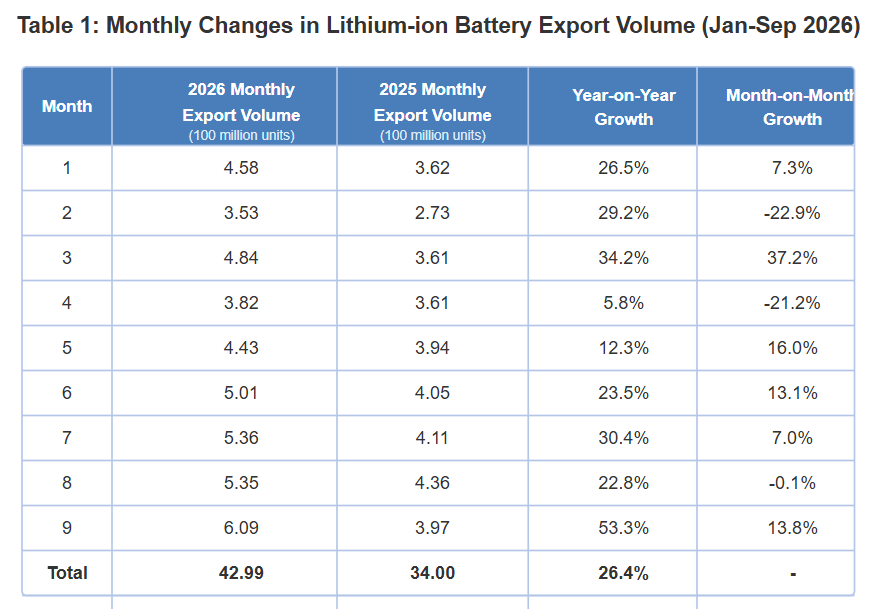
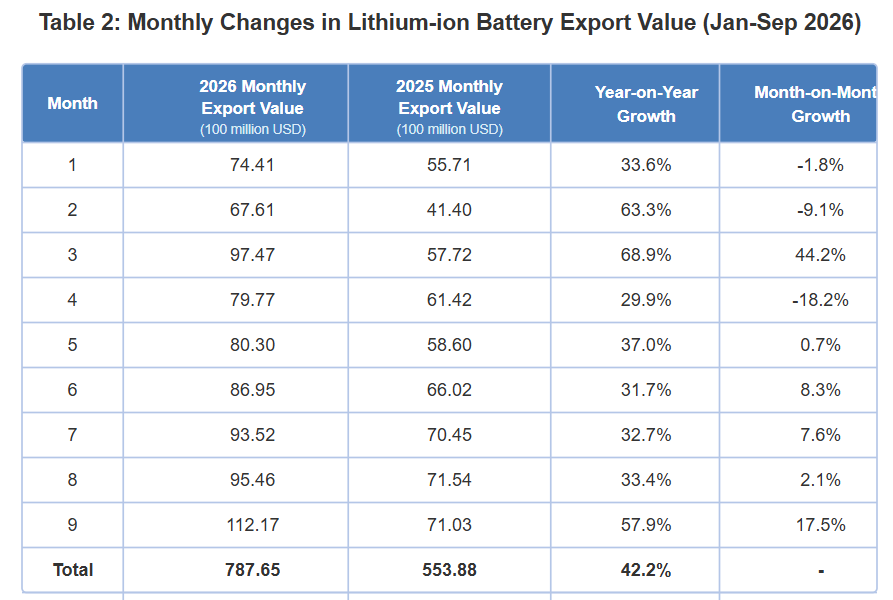
According to customs statistics, from January to September 2026, China's lithium-ion battery export volume reached 4.3 billion units, a year-on-year increase of 26.4%; export value reached US$78.77 billion, a year-on-year increase of 42.2%. In September alone, export volume was 609 million units, up 53.3% year-on-year and 13.8% month-on-month; export value was US$11.22 billion, up 57.9% year-on-year and 17.5% month-on-month. The trend of rising volumes and prices has been further consolidated, and export resilience continues to stand out. In September, lithium-ion battery exports strengthened both year-on-year and month-on-month, and the growth rate of export value continued to exceed that of volume, reflecting a rising share of high-value-added categories in export products, with strong growth in exports of energy storage battery systems, large-capacity cells, and other high-value products.
The main contributing factors include: First, overseas energy storage has entered its peak demand season, with concentrated delivery of large-scale energy storage projects in Europe, the Middle East, Latin America, and other regions, coupled with robust restocking demand for residential storage and grid-side storage in European markets such as the Netherlands. Second, policy expectations have driven forward shipments. Under current policy, the VAT export tax rebate rate for batteries was lowered from 9% to 6% starting April 2026 and will be abolished from January 1, 2027. Enterprises are accelerating export pace to lock in orders and seize the year-end window.
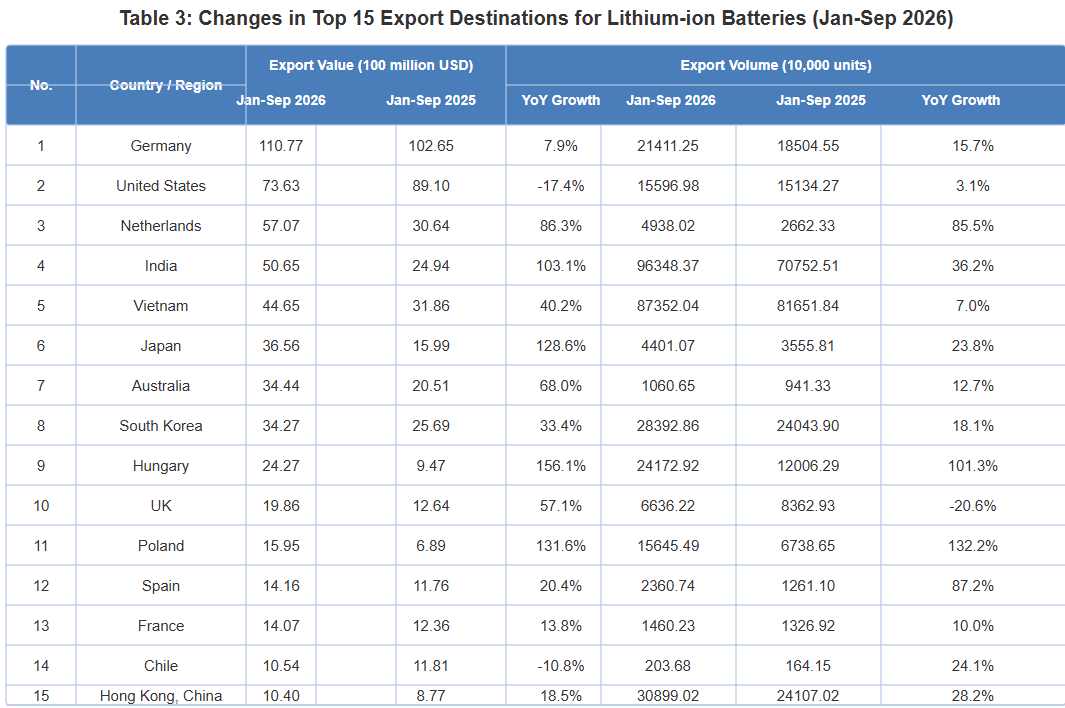
Germany is China's largest export market for lithium-ion batteries. From January to September 2026, China's exports to Germany reached US$11.08 billion, up 7.9% year-on-year, accounting for 14% of China's total lithium-ion battery exports. As the core hub of Europe's new energy vehicle and energy storage industries, Germany remains China's largest importer of lithium-ion batteries. The United States is the second-largest export market. From January to September 2026, China's exports to the US amounted to US$7.363 billion, down 17.4% year-on-year, accounting for 9.3% of total exports. The Netherlands is the third-largest export market. China's exports to the Netherlands reached US$5.707 billion, up 89.3% year-on-year, accounting for 7.2% of total exports. The strong growth in exports to the Netherlands is primarily driven by concentrated release of transshipment demand for energy storage batteries: the Port of Rotterdam is a core re-export hub for Asian cells entering Europe, with large volumes of Chinese lithium-ion batteries transshipped through the Netherlands to end markets in Germany, France, Central and Eastern Europe.
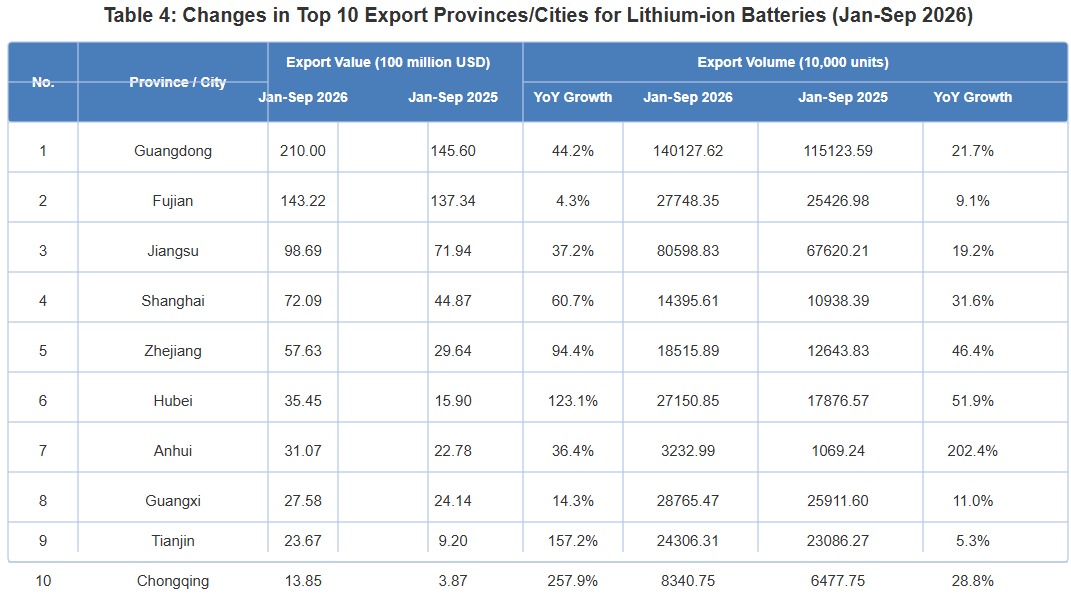
From January to September 2026, Guangdong Province was the largest source of China's lithium-ion battery exports, with export value of US$21 billion, up 44.2% year-on-year, accounting for 26.7% of China's total lithium-ion battery exports; export volume was 1.4 billion units, up 21.7% year-on-year. Fujian Province ranked second, with export value of US$14.322 billion, up 4.3% year-on-year, accounting for 18.2%; export volume was 280 million units, up 9.1% year-on-year. Jiangsu Province ranked third, with export value of US$9.87 billion, up 37.2% year-on-year, accounting for 12.5%; export volume was 806 million units, up 19.2% year-on-year. The combined export value of Guangdong, Fujian, and Jiangsu accounted for 57.4%, forming the core foundation of China's lithium battery exports.
From January to September 2026, among the top ten provinces by export value, the three with the largest increases were Chongqing Municipality, Tianjin Municipality, and Hubei Province, with export value growth of 257.9%, 157.2%, and 123.1% respectively; the three provinces and municipalities with the largest increases in export volume were Anhui Province, Hubei Province, and Zhejiang Province, with export volume growth of 202.4%, 51.9%, and 46.4% respectively. This reflects a development trend of tiered transfer of production capacity toward the central and western regions and concentrated volume release from new bases.
On September 28, the Ministry of Industry and Information Technology and six other departments issued the "15th Five-Year Plan for the Development of the New Battery Industry," setting clear goals including preliminary large-scale application of all-solid-state batteries by 2030 and a cycle life of 15,000 cycles for long-life lithium-ion batteries, and listing improvement of the quality of trade and investment cooperation as a key task, guiding enterprises to go global in a diversified and orderly manner. At the same time, compliance thresholds on the export side continue to rise: the EU Battery Regulation's carbon footprint declaration for energy storage batteries has officially taken effect, and from August 2026, EU customs will enter a phase of mandatory random inspections of carbon footprint declarations and battery passport data for imported power and energy storage batteries; US FEOC rules continue to tighten. The threshold for enterprises going global is shifting from tariff costs to localized delivery and compliance capabilities.
Overall, in September, China's lithium-ion battery exports continued the trend of rising volumes and prices, structural upgrading, and market differentiation, with production capacity in the central and western regions continuing to be released. With the implementation of the 15th Five-Year Plan and the improvement of overseas compliance capabilities, China's lithium-ion battery exports are expected to maintain "stable volumes and rising value" in the fourth quarter.
Source: China Chemical and Physical Power Industry Association