When you visit an energy storage project site, buy an electric vehicle, or look at a charging pile, you will encounter these letters: Ah, Wh, kWh. 100Ah, 280Ah, 60kWh, 120kW… you see them every day, but many people still wonder:
What exactly is Ah? How many kilowatt-hours is 100Ah? Why do battery manufacturers say 280Ah while car companies say 60kWh? Today, let's not beat around the bush. Here is a one-sentence summary first, and everything that follows will revolve around it:
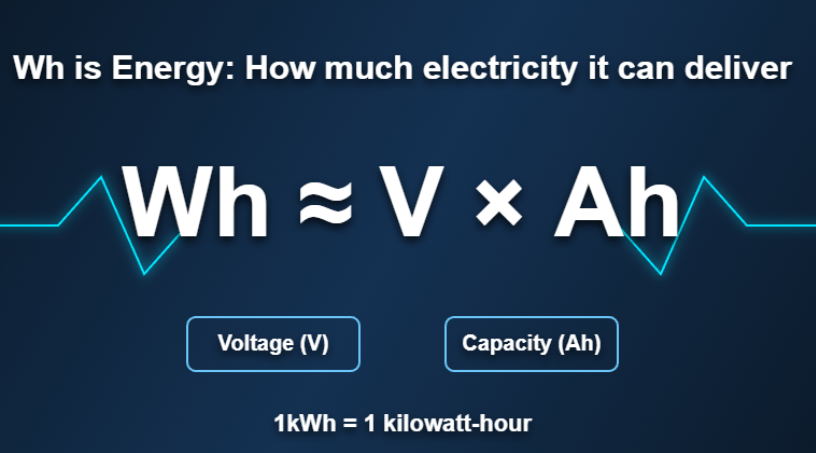
Ah is the battery's "capacity"—how much charge it can release; Wh/kWh is the battery's "energy"—how much electricity it can deliver. The bridge between them is voltage: Wh ≈ V × Ah.
# 01 Ah: The Battery's Capacity—How Much Charge It Can Release
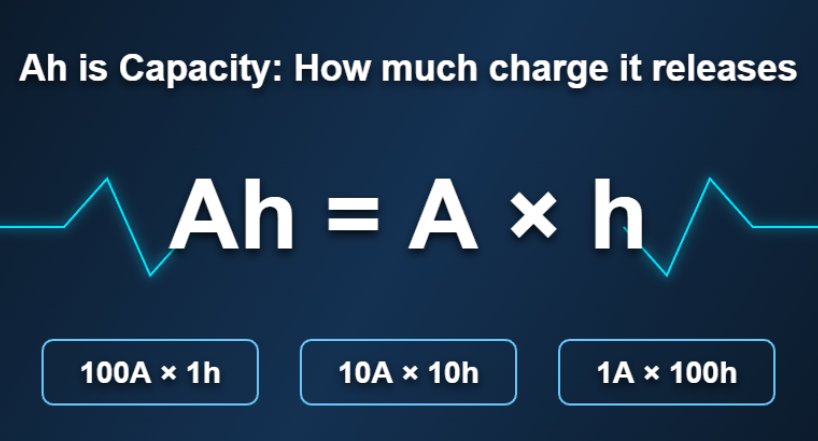
Ah stands for Ampere-hour. It breaks down into two letters: A is current (Ampere), and h is hour. So Ah = current × time. It answers the question: how much charge this battery can provide. 100Ah can be roughly understood as: 100A for 1 hour, or 10A for 10 hours, or 1A for 100 hours—the total charge released is about the same. A real battery is not this ideal; internal resistance, temperature, discharge rate, and the BMS will all hold it back, but remember this intuition first. This is also why cell manufacturers like to use Ah. When a lithium iron phosphate cell is labeled "280Ah," engineers know its charge capacity at a glance.
# 02 Wh/kWh: The Battery's Energy—How Much Electricity It Can Deliver
Wh stands for Watt-hour, an energy unit. 1000Wh = 1kWh, and 1kWh is what we commonly call 1 kilowatt-hour of electricity. How is energy calculated? Wh = V × Ah (voltage × capacity). Take a 3.7V, 100Ah cell as an example: 3.7 × 100 = 370Wh, which is 0.37 kilowatt-hours. So remember: Ah says "how much charge," Wh says "how many kilowatt-hours"—the difference between the two is a voltage.
# 03 Here's the Key: Why "100Ah" Does Not Equal "100 Kilowatt-Hours"
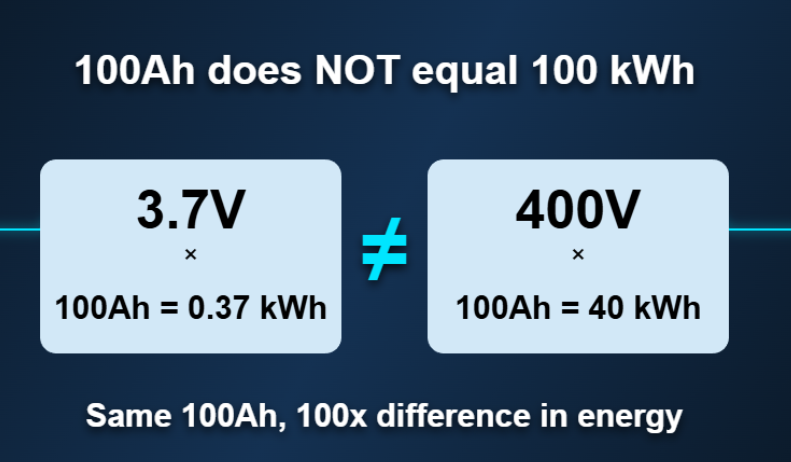
Many people hear 100Ah and ask, "Is that 100 kilowatt-hours?"—this is the biggest pitfall. The same 100Ah, with different voltages, has vastly different energy:
3.7V × 100Ah = 0.37 kWh
12V × 100Ah = 1.2 kWh
48V × 100Ah = 4.8 kWh
400V × 100Ah = 40 kWh
The same "100Ah" can differ in energy by 100 times. So in the future, when you see "280Ah," the correct first reaction is not "how many kilowatt-hours," but to ask: what is the nominal voltage? A 3.2V 280Ah cell has about 0.9 kWh of energy; install it into a 400V battery pack, and it becomes over a hundred kilowatt-hours.
# 04 How Cells Become Battery Packs: Series Raises Voltage, Parallel Adds Capacity
A battery pack = cells in series and parallel. Take a 3.2V/100Ah cell as an example:
4 in series (4S): voltage becomes 12.8V, capacity remains 100Ah → energy 1.28kWh
4 in parallel (4P): voltage remains 3.2V, capacity becomes 400Ah → energy still 1.28kWh
See that? Series raises voltage, parallel adds capacity, and energy can be stacked up either way; but the voltage, current, power, and BMS design are completely different. So when looking at a battery pack, you cannot look only at Ah—voltage, capacity, energy, and power must be considered together.
# 05 What It Means for You: How to Use These Three Numbers
Why do new energy vehicles label kWh? Because consumers care about "how much electricity it can hold"—60kWh is about 60 kilowatt-hours. Why do charging piles label kW? Because they care about "how fast it charges"—120kW is power, the speed of energy transmission. One-sentence mnemonic: kWh is "how much water the tank can hold," kW is "how much water flows per second from the pipe." One is "how much," the other is "how fast." A complete battery set: 400V / 150Ah / 60kWh—the trio of voltage, capacity, and energy, 400 × 150 = 60kWh, it checks out.
| Unit | Chinese | What Question It Answers | Common Scenarios |
|---|
| A | Ampere | How large the current is | Charge/discharge current |
| Ah | Ampere-hour | How much charge can be released | Cell, battery capacity |
| W/kW | Watt/kilowatt | How fast energy is transmitted | Charging pile power |
| Wh/kWh | Watt-hour/kilowatt-hour | How much energy is stored in total | EV, energy storage, electricity meter |
Remember this closing line: when buying a battery, look at Ah; when calculating electricity, look at Wh/kWh; when you see Ah, ask about voltage first—don't blurt out "how many kilowatt-hours" right away.
Once you understand these three letters, when you look at energy storage projects and EV specifications again, you won't be intimidated by numbers like "280Ah." A battery is not better just because the number is bigger—it is "voltage × capacity" that decides.
Source: Dr. Zeng's Daily Life