I. What Does Energy Storage Need Battery Cells to Do?
The requirements that energy storage scenarios place on battery cells are completely different from those of electric vehicles:
EVs need “high energy density, light weight, and long range,” so NMC is the mainstay. Energy storage needs “cheap, safe, and long-lasting,” so LFP is the mainstay. Their priorities are almost opposite.
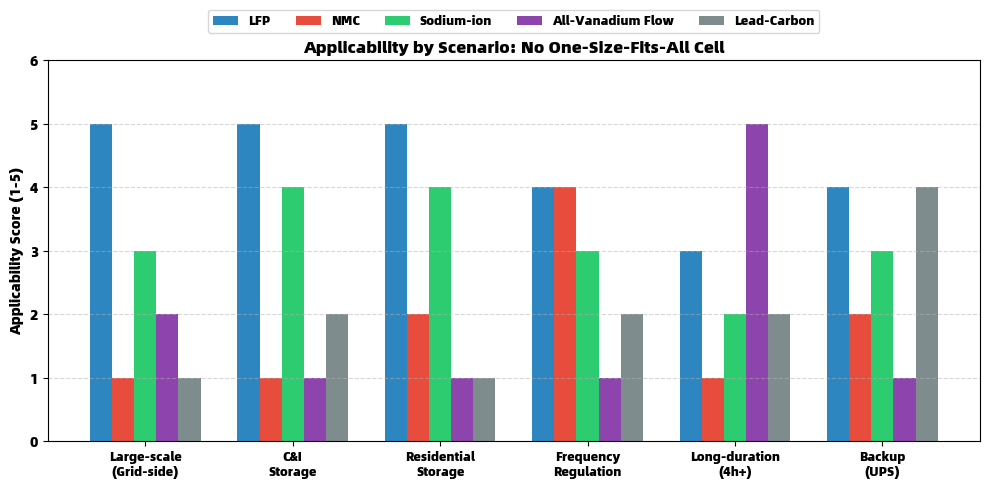
But energy storage is not a single scenario either. Even with the same battery installation, frequency regulation plants charge and discharge hundreds of times a day, but each discharge lasts only a few minutes. Long-duration storage discharges once a day, but each discharge lasts six hours.
The requirements for battery cells are vastly different. So first clarify the needs:
Grid-side large-scale storage: cost first, safety second, cycle life third. For a 200 MWh station, a difference of 0.1 yuan per kWh amounts to 20 million yuan.
Commercial and industrial energy storage: limited space, so energy density cannot be too low; peak-valley arbitrage, one or two full cycles per day.
Frequency regulation ancillary services: require high-frequency shallow cycling; power characteristics are more important than energy characteristics.
Long-duration storage (4h+): the competition is over lifecycle cost; initial cost is secondary.
This demand map determines the positioning of each of the five cell types. Below, we break them down one by one in order of market share from largest to smallest.
II. LFP Lithium Iron Phosphate: Not the Best, but Top Three Across the Board
This is currently the “default option” in the energy storage industry.
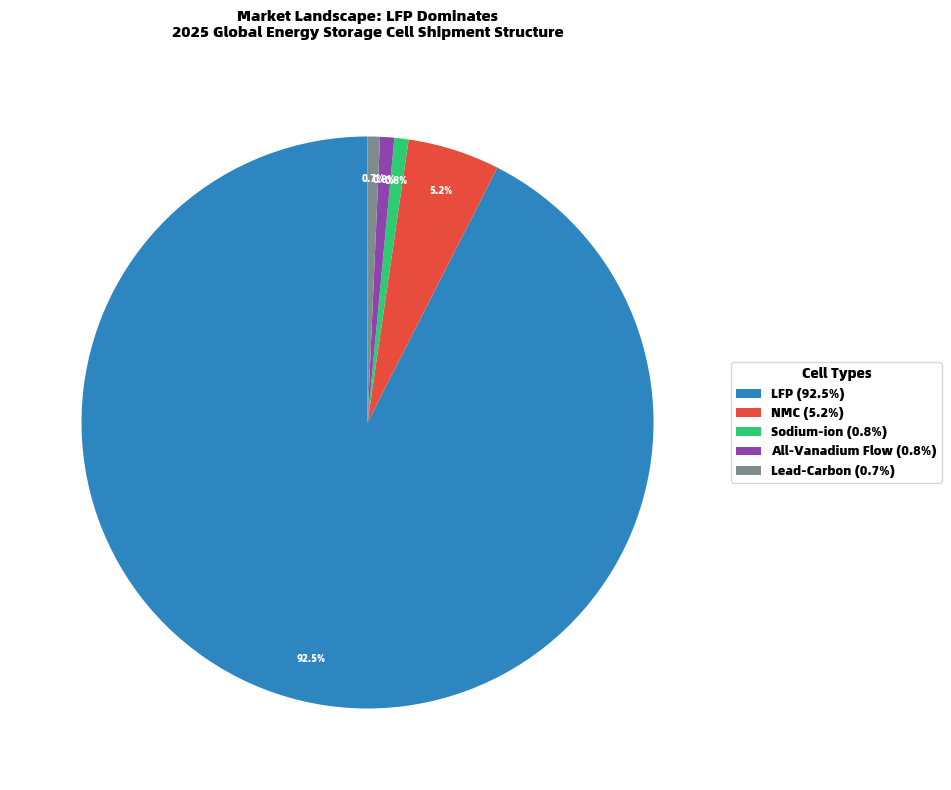
Global energy storage cell shipments were 320 GWh last year, with LFP accounting for 92.5%. CATL alone accounted for nearly 40%, followed closely by EVE Energy and BYD.
This is not because it is the strongest in every single category, but because it has no fatal weaknesses:
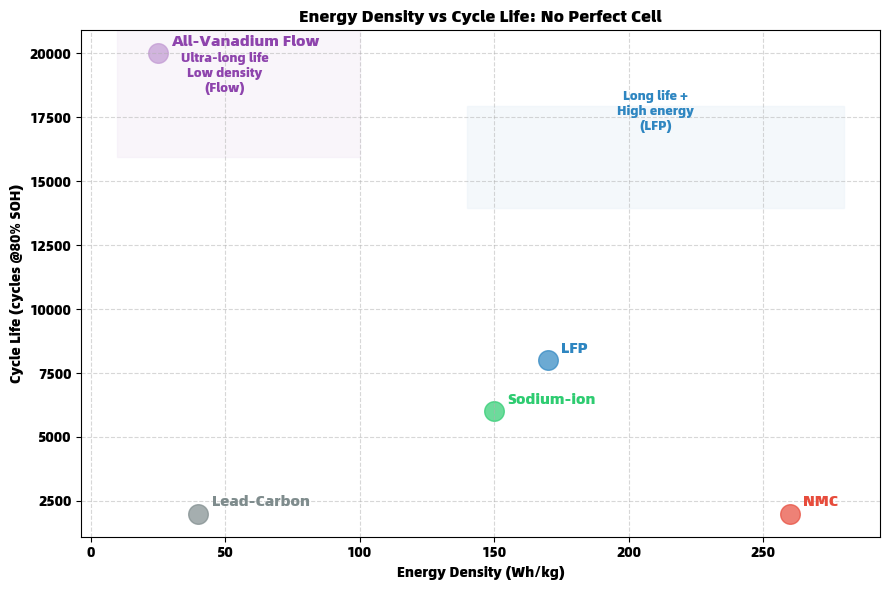
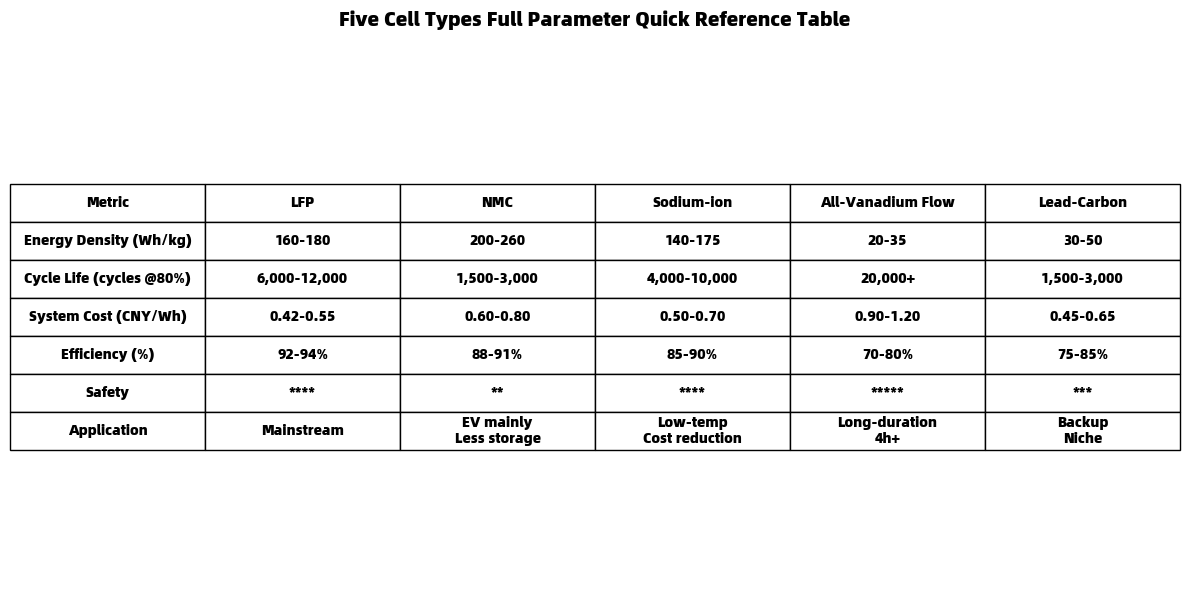
Energy density: 160–180 Wh/kg, sufficient. Energy storage is not as weight-sensitive as EVs.
Cycle life: 6,000–12,000 cycles (to 80% capacity); calendar life: 10–15 years.
System cost: 0.42–0.55 yuan/Wh; the full-year average price in 2025 was about 0.45 yuan, still falling, but room is limited.
Safety ★★★★: thermal runaway onset temperature 180–220°C; no fire in nail penetration; an order of magnitude safer than NMC.
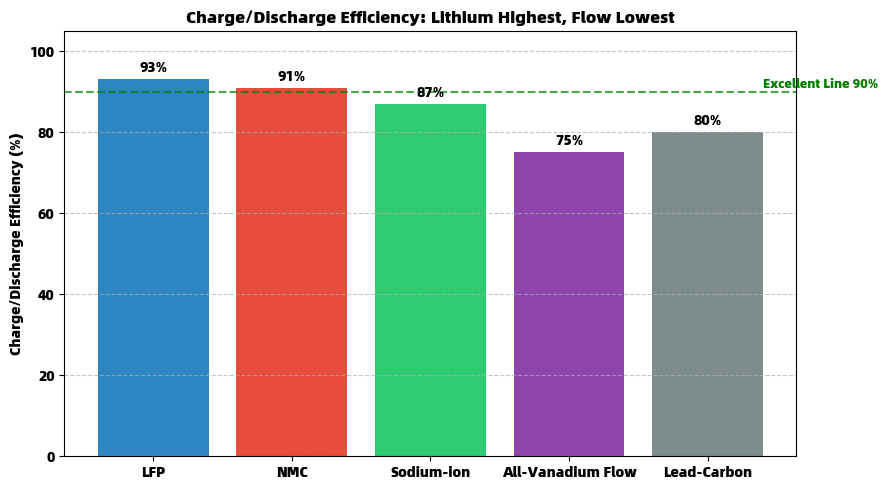
Charge-discharge efficiency: 92–94%, the least electricity “loss.”
Why can LFP be so cheap? Scale.
In 2025, China’s energy storage battery output was 557 GWh, almost twice global installed demand, resulting in severe oversupply. The lowest winning bid price for cells has already reached 0.26 yuan/Wh, below the manufacturing cost line of most manufacturers.
But this also means: the room for price reductions has basically bottomed out; the next competition is on technology and brand.
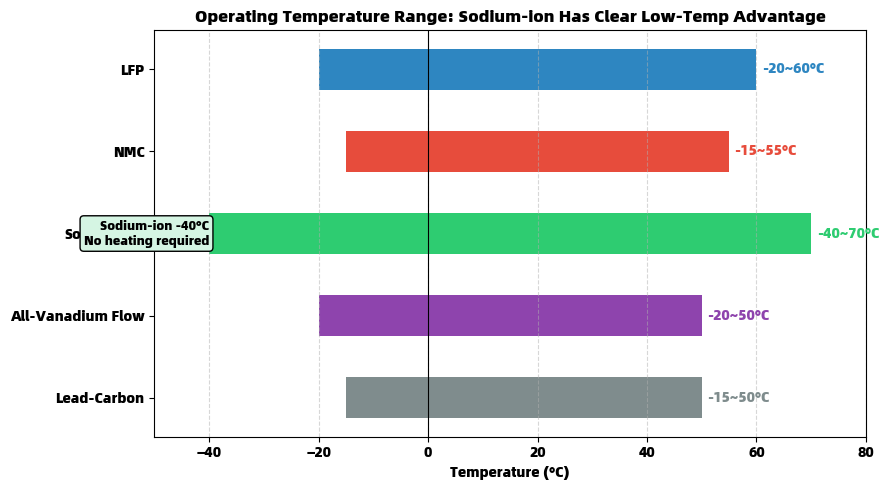
Where is LFP weak? Low temperature. At temperatures in the minus teens, performance drops noticeably and PTC heating is needed, but this is a problem in residential energy storage and high-latitude projects. Apart from that, it is the “safety baseline” for energy storage selection—when making any comparison, first use LFP as a benchmark.
III. NMC Lithium Nickel Manganese Cobalt Oxide: High Energy Density Comes at a Cost
NMC is the mainstay of EVs, accounting for just over 20% of power batteries. But in energy storage, its share has shrunk from “half the market” ten years ago to just over 5%. The fundamental reason is that energy storage cannot tolerate its three shortcomings:
Short cycle life: 1,500–3,000 cycles, only one-fourth to one-half that of LFP.
Poor safety: thermal runaway onset temperature 150–200°C; cobalt-containing cathode materials make firefighting extremely difficult.
High system cost: 0.60–0.80 yuan/Wh, 30–40% more expensive than LFP.
But it has a long suit that LFP cannot replace: energy density of 200–260 Wh/kg, nearly 50% higher. In scenarios with extremely limited space, such as rooftop energy storage on old buildings, or mobile energy storage that is sensitive to weight, NMC still has a place.
However, as LFP energy density increases year by year—currently cells have reached 180+ Wh/kg—NMC’s energy storage market will become narrower and narrower.
IV. Sodium-Ion: A “Drop-in Substitute” for Lithium, Cost Reduction Still Underway
This is the most closely watched new technology route in 2024–2025. The logic of sodium-ion is simple: sodium reserves are 400 times those of lithium, and raw material cost is almost zero.
Current commercial sodium-ion parameters:
Energy density: 140–175 Wh/kg, slightly lower than LFP, but not by much.
Cycle life: 4,000–10,000 cycles. CATL’s Naxtra has achieved 10,000 cycles, already catching up with LFP.
Cost: about 0.50–0.70 yuan/Wh; not yet mass-produced at scale; the theoretical lower limit should be significantly lower than LFP.
Sodium-ion’s real killer feature is low-temperature performance. At -40°C it can still retain 85–90% capacity without any heating.
LFP at -20°C has already dropped to 60–80% and requires heating. In Northeast China, Xinjiang, Tibet, and other regions, this alone is enough for sodium-ion to turn the tables.
But at this stage sodium-ion still faces two problems:
Production scale is too small. In 2025, global sodium-ion capacity was less than 5 GWh, so economies of scale cannot be achieved, and the cost advantage cannot manifest.
The supply chain is immature. Cathode materials are still being selected; among the three routes of layered oxides, polyanionic compounds, and Prussian blue, there is no winner yet, and hard carbon anode supply is also unstable.
In 2026, CATL and BYD are both accelerating sodium-ion mass production lines. If sodium-ion costs truly fall below LFP in 2027–2028, only then will LFP’s monopoly position in energy storage be truly shaken.
V. All-Vanadium Flow: The Only Option for Ultra-Long-Duration Storage
If LFP and sodium-ion are competing for “the cheapest cell,” then all-vanadium flow is competing for “the longest-lasting.”
In flow batteries, energy is stored in electrolyte tanks, and the stack is merely a “reactor.” This design brings three unique advantages:
Cycle life of more than 20,000 cycles, with almost no degradation. The electrolyte reaction is reversible; electrodes do not “wear” with each charge-discharge like lithium batteries.
Power and capacity are decoupled. To add capacity, add more electrolyte tanks; to add power, add more stacks. The two scale independently.
Absolutely safe. Aqueous electrolyte: no fire, no explosion.
The costs are also obvious:
Energy density is only 20–35 Wh/kg. For the same 1 MWh, flow batteries occupy three to four times the area of LFP.
Charge-discharge efficiency is 70–80%. For every charge-discharge cycle, a quarter becomes heat.
Initial cost is 0.90–1.20 yuan/Wh, two to three times that of LFP.
So why does it win long-duration storage? Because of its 25-year full lifecycle cost.
Assume a 4h energy storage project runs for 25 years:
LFP needs cell replacement every 10–12 years; after two replacements, the 25-year total cost is 0.18–0.28 yuan/kWh. Flow batteries do not need cell replacement; the 25-year total cost is 0.11–0.17 yuan/kWh.
If it can truly last 25 years, flow is cheaper.
The hundred-megawatt-scale flow battery projects currently in Liaoning, Xinjiang, and other places follow exactly this logic: long cycle, large capacity, and calculating the full lifecycle account.
VI. Lead-Carbon: The Veteran Is Not Dead, Just Marginalized
Lead-acid batteries have lived for 150 years. After carbon improvement, they are called “lead-carbon”—cycle life increased from a few hundred to two to three thousand cycles, and efficiency increased from 60% to 75–85%.
Its share of the energy storage market has fallen to less than 1%, but that does not mean it is completely useless. Its advantages are:
The most mature recycling system. Lead recycling rate exceeds 99%, more complete than any lithium battery system.
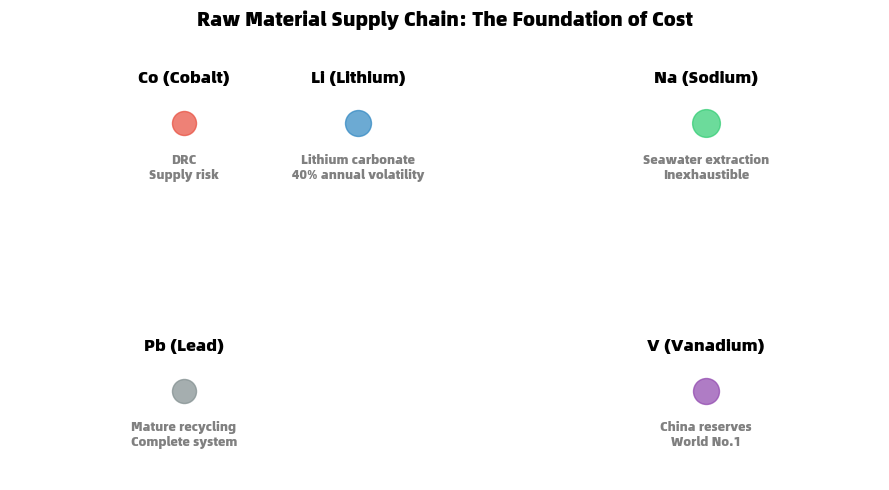
Low and stable cost. Lead prices do not fluctuate 40% a year like lithium carbonate.
Good float-charge characteristics. When used as UPS backup power, it is almost the most economical solution.
But for mainstream energy storage—core assets that cycle daily and need to last more than a decade—lead-carbon is no longer within the scope of competitiveness. Its positioning is clear: “backup power, niche, specific scenarios.” Where frequent charging and discharging is not required and it is only kept for occasional use, lead-carbon has the lowest unit backup cost.
VII. Understand the Comprehensive Comparison of Five Cell Types in One Chart
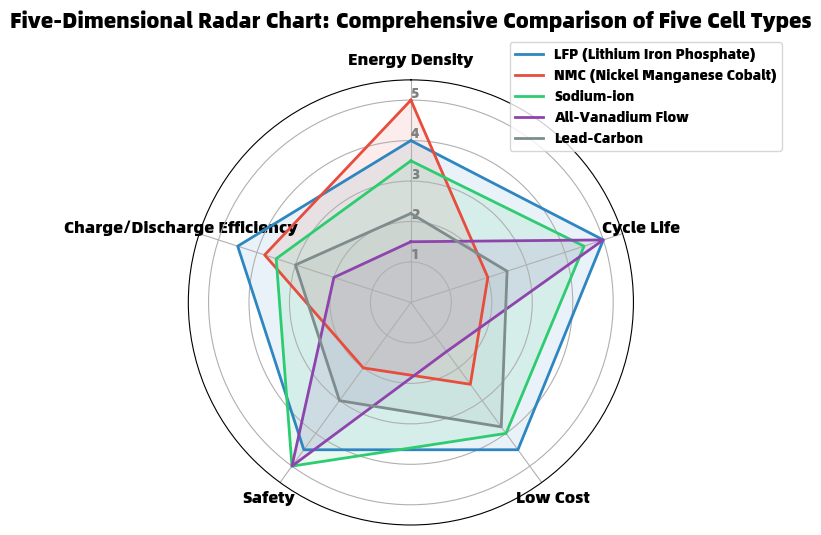
Plot the five core indicators as a radar chart:
LFP (blue): No single metric is outstanding, but all are between 3.5 and 4.5; top three across the board, with no shortcomings.
NMC (orange): Energy density pulled to 5, but safety and cost fall to 2; a severe “uneven student.”
Sodium-ion (green): Steady and balanced, with extra points for low temperature, but currently more like “LFP’s spare tire” rather than a replacement.
All-vanadium flow (purple): Safety and lifespan maxed at 5, but energy density and efficiency only reach 1–2; extremely lopsided.
Lead-carbon (gray): Every metric is between 2 and 3; mediocre but not too bad.
VIII. Market and Technology Trends: Three Things Are Happening
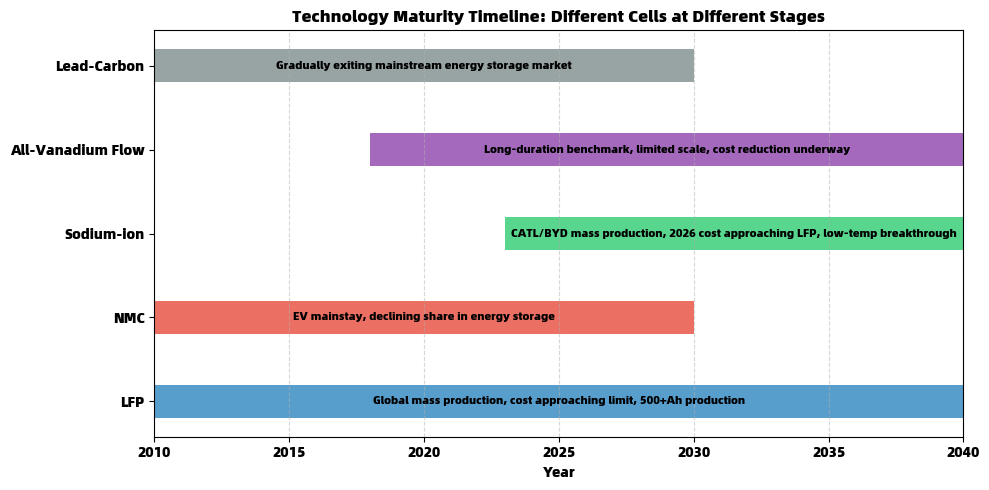
First, the large-cell race. From 280 Ah in 2023 to 314 Ah in 2024, now CATL 587 Ah, EVE 628 Ah, and Sunwoda 684 Ah.
The “500+ Ah” era has arrived. Larger cells mean fewer connection points, lower system cost, and higher integration efficiency.
Second, sodium-ion mass production is accelerating. CATL’s Naxtra second generation costs about $77/kWh, already approaching LFP. Once sodium-ion capacity exceeds 20 GWh in 2027 and forms economies of scale, prices will be pushed below LFP.
Third, flow battery scaling. Dalian Rongke Power’s 200 MW/800 MWh all-vanadium flow battery project was commissioned in 2024—the world’s largest. Its operating data will become a reference benchmark for the entire industry.
IX. Selection Principles: There Is No Best Cell, Only the Most Suitable Cell
If your project is: two-hour commercial and industrial energy storage, one charge-discharge per day, operating for ten years: choose LFP without hesitation.
If your project is: a PV-storage integrated project in Northeast China, -30°C, with no one to maintain it: wait for sodium-ion, or first use LFP and factor in the cost of heating energy consumption.
If your project is: grid-side long-duration storage of 4 hours or more, requiring a 25-year life, where the greater the electricity throughput the better: calculate the full lifecycle account of all-vanadium flow; the pitfall of high initial cost may be offset by savings from avoiding cell replacement.
In one sentence: translate your own needs into parameters, then map the parameters to cell types. There is no battery that wins everywhere, only the right battery.
X. Summary
The positioning of the five cell types is already very clear:
LFP lithium iron phosphate: currently the optimal choice for energy storage, top three across the board; its 92.5% market share is not for nothing. Its only disadvantage is low temperature.
NMC lithium nickel manganese cobalt oxide: the cost of high energy density is short life, poor safety, and high price; it continues to decline in the energy storage field.
Sodium-ion: the new route most likely to challenge LFP; low temperature is its killer feature, and scaling after 2027 is the key word.
All-vanadium flow: the only option for long-duration storage; initially expensive but possibly the cheapest over the full lifecycle.
Lead-carbon: niche backup power, not for core assets.
Source: Solar-Storage Engineer 3088