Lithium-ion Battery Monthly Research Report | September 2026
Publishing Institution: Voltrix Industry Research Center
Release Date: October 10, 2026
Report Positioning: For upstream and downstream practitioners and investors in the lithium-ion battery energy storage industry chain, this is a monthly technical assessment. This report does not summarize news; it answers only three questions—what the key variable of the month is, what engineering logic it changes, and what the industry chain will compete on in the next stage.
Contents
I. Core Judgment: Verification Capability Becomes the New Axis of Industry Chain Competition
II. Policy Trends: Compliance Moves from "Certification" to "Data Verification"
III. Technology Iteration: The First Year of 500+ Ah Mass Production—Generational Switch Enters the Verification Phase
IV. Industry Chain Dynamics: Cost Discipline and Delivery Engineering Under Lithium Price Revaluation
V. Segment Tracks: Verification Thresholds Determine Track Divergence
VI. Capital and Trade: Safety Incidents Revalue Quality Weight; Capital Prices Engineering Capability
VII. Comprehensive Industry Prosperity Judgment (PISTER) and Next Month's Observation Indicators
VIII. Risk Warnings: Marginal Variables from an Engineering Perspective
IX. Appendix: Core Data Comparison Table and Disclaimer
I. Core Judgment: Verification Capability Becomes the New Axis of Industry Chain Competition
The most important change in the industry in September is not in any single data set, but in the underlying rules of competition: from October 1, the EU imposes dual mandatory compliance on exported energy storage—IEC 62933-5-2 cybersecurity type certification and full life-cycle carbon footprint MRV reporting—turning verification from corporate self-discipline into market access; 500+ Ah cells went from "next generation" to "current generation" in less than a year, with Pylontech, HiTHIUM, Rongjie, CATL, and Envision AESC successively delivering in batches; at the same time, lithium carbonate prices fell about 24% in a single month to RMB 120,000/t, and three energy storage fires occurred in the U.S. and South Korea within four days. Putting these signals together, there is only one conclusion: the axis of industry competition is shifting from "production capacity scale" to "verifiable engineering capability."
Three groups of shifts constitute the main line of this month's judgment:
First, policy moves from "certification" to "data verification." Article 68 cybersecurity type certification of the EU Battery Regulation, full life-cycle carbon footprint MRV, recycled material content verification, and battery passport form a four-fold traceable compliance chain; CBAM will enter the substantive levy stage on January 1, 2026. The object of verification extends from "the product itself" to the "full life-cycle data chain"—whoever has a complete, auditable data chain has market access qualification. This is a direct test of supply chain data management capability.
Second, technology moves from "parameter competition" to "mass production verification." 587 Ah is publicly listed at RMB 0.415/Wh, with capacity about 87% higher than 314 Ah and unit price only about 3% higher; Pylontech's 588 Ah/601 Ah was mass-produced in Hefei on September 21 and achieved batch delivery of over 100 MWh; HiTHIUM's ∞Cell 587 Ah shipped from its Texas plant in the U.S. The bottleneck of the generational switch is no longer cell design, but mass production verification of electrode consistency, winding yield, and module tolerance—leading manufacturers publicly price this capability, and the line economics of second-tier manufacturers are thereby directly tested.
Third, demand shifts from "spot procurement" to "framework lock-in." EVE Energy signed a 206 GWh five-year supply framework with Fluence (16 GWh committed delivery in 2027, 190 GWh reserved for 2028–2031). The upgrading of order forms pushes the focus of competition toward certification completeness (UL, FEOC compliance), FAT acceptance, and overseas localized delivery systems.
In the same month, there were also two warnings: the fifth fire at Moss Landing in five years, and the total loss of 28 battery packs at KEPCO's Daejeon Research Institute in South Korea, elevating energy storage safety from a technical issue to a public constraint; under violent lithium price fluctuations, inventory management and the engineering discipline of long-term contract price locking are becoming a life-and-death line for midstream companies.
This month's comprehensive prosperity index is 8.90 (9.00 last month), still at a high level, but the structure is changing: policy and technology maintain strong support, while supply chain and investment ends pull back due to price fluctuations. The industry has not turned cold; the competitive exam has simply changed from "capacity" to "verification."
II. Policy Trends: Compliance Moves from "Certification" to "Data Verification"
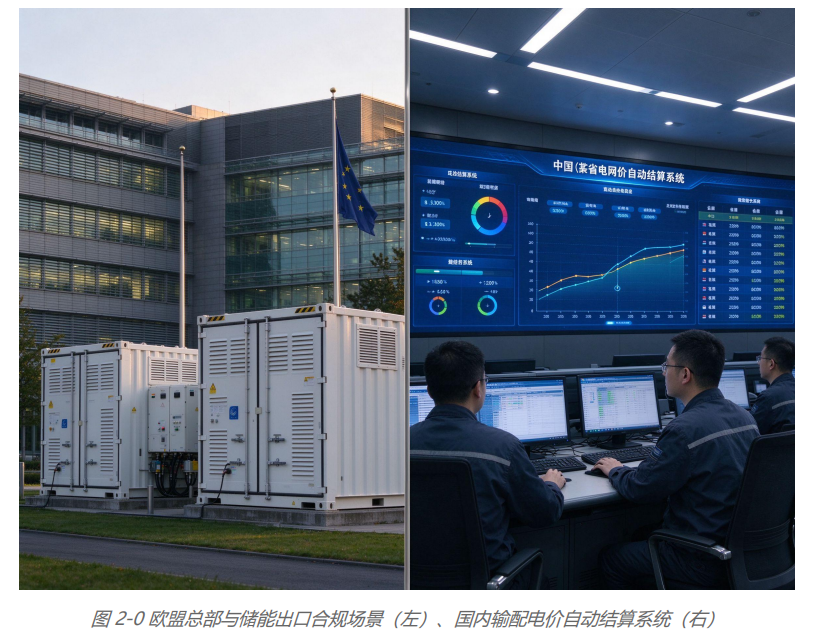
Figure 2-0 EU headquarters and energy storage export compliance scenario (left), domestic transmission and distribution price automatic settlement system (right)
The EU Battery Regulation enters a密集 period of entry into force in September–October, and energy storage export compliance upgrades from "single certification" to "multiple verification": from October 1, energy storage systems exported to the EU must simultaneously meet IEC 62933-5-2 cybersecurity type certification and full life-cycle carbon footprint MRV reporting requirements; from August 18, industrial batteries with capacity greater than 2 kWh must be labeled with a CO2 footprint performance class; the delegated regulation on calculation and verification of recycled material content completed the legislative process in Q3, and the battery passport guidance was updated on August 21. CBAM will enter the substantive levy phase on January 1, 2026.
Laying out the timeline, the EU's logic is clear: it no longer uses a single tariff or single certification as the threshold, but strings "product safety (certification)—carbon footprint (MRV data)—recycled materials (content verification)—cybersecurity (type certification)—data chain (battery passport)" into an auditable compliance chain. The hardest part to pass is not the certification itself, but full life-cycle data verification—carbon footprint MRV requires energy consumption and emission data at every level of the supply chain to be traceable and verifiable. This is a new dimension never covered by traditional export certification systems.
(1) Engineering-oriented Operation of Document No. 1077: Revenue Model Shifts from "Policy Arbitrage" to "Engineering-oriented Operation"
On the domestic side, as Document No. 1077 entered September after implementation on August 1, the focus has shifted from the "charge refund/discharge reduction" mechanism itself to its automatic operation in provincial grid electricity fee settlement systems—it is no longer a one-time policy bonus, but a continuously operating revenue rule. As of the end of September, more than 20 provinces had forwarded or issued implementation rules for transmission and distribution prices in the fourth regulatory cycle. Hebei (July 27), Liaoning (July 31), Zhejiang (July 29), Jiangxi (July 31), Fujian (July 31), Guizhou (Qian Fa Gai Jia Ge [2026] No. 421), among others, have clarified that "grid-side independent energy storage shall temporarily execute transmission and distribution prices under a single electricity quantity system when charging, and correspondingly refund/reduce transmission and distribution fees for discharged electricity," effective August 1; Chongqing and Sichuan forwarded in August, and Qinghai and other northwestern provinces followed in September, showing an overall rhythm of "north first, south follows, northwest concludes."
Differences in implementation progress are becoming differences in engineering decisions: in provinces that have implemented automatic settlement, project revenue models are clear, and Q4 is highly likely to see concentrated construction starts; in provinces still soliciting opinions, owners remain in the feasibility study and pre-tender stage. For equipment suppliers and engineering service providers, the sequence of order windows can already be predicted by ranking provincial policy statuses.
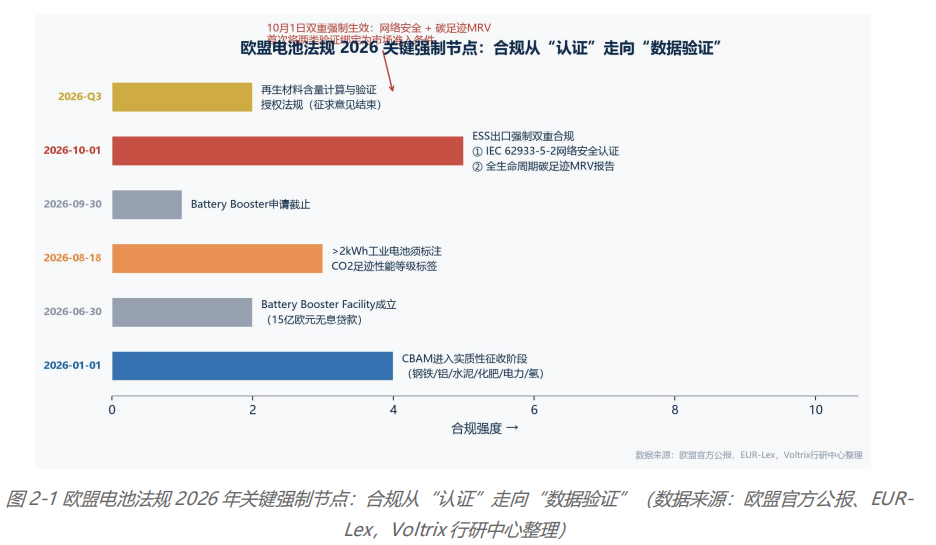
Figure 2-1 Key mandatory nodes of the EU Battery Regulation in 2026: Compliance moves from "certification" to "data verification" (Source: Official Journal of the European Union, EUR-Lex, compiled by Voltrix Industry Research Center)
(2) Qinghai 2 GW/8 GWh: Long-duration Energy Storage Moves from Demonstration to Batch Tendering
On September 3, Qinghai released the first batch of grid-side independent energy storage project tenders for 2026, with a total scale of 2 GW/8 GWh, divided into 5 lots, and storage duration of no less than 4 hours—this is the second province in the northwest after Inner Mongolia to launch GWh-level independent energy storage batch tendering. In early October, tender activity continued: two independent energy storage EPC projects in Xining, Qinghai, totaling 600 MW/2.2 GWh, and a 100 MW/200 MWh energy storage EPCO in Suzhou, Anhui (including power trading and capacity leasing O&M), were successively posted online. The tender format extends from "delivery EPC" to "delivery + operation."
The engineering implications of the tender are more noteworthy than the scale: first, the 4-hour-plus long-duration requirement directly constrains system design—PCS capacity configuration, liquid cooling schemes, and transformer selection must all be checked under long-duration operating conditions; second, site selection shifts from supporting new energy stations to independent configuration at 750 kV grid nodes (Kunlun Mountain and Tuosu substations). Energy storage is changing from a "power station accessory" to a "grid asset," and its grid-connection acceptance, dispatch agreements, and O&M systems will all move toward grid-side standards. Capacity electricity prices and Document No. 1077 are aligned in this direction.
(3) Battery Consumption Tax Exemption Window: One-time Improvement in the Cost Structure of Next-generation Technologies
The battery consumption tax policy implemented in July set an approximately two-and-a-half-year exemption window for six categories of next-generation technologies including sodium-ion, solid-state, and fuel cells. The consumption tax rate itself is not high, and its impact on current costs is limited; however, the signal value lies in the shift of policy support from "R&D subsidies" to "tax incentives." The full life-cycle cost model of next-generation technologies now has one less deterministic expenditure, which helps advance production line investment decisions.
Engineering service perspective: compliance is moving from "certification" to "data verification," and the object of verification extends from products to the full life-cycle data chain. Carbon footprint MRV, battery passport data chains, cybersecurity type certification, and recycled material content verification all require independent third parties to issue auditable, traceable verification reports—for independent service providers with engineering technology verification as their core capability, this is a structural change from "optional service" to "market access infrastructure."
III. Technology Iteration: The First Year of 500+ Ah Mass Production—Generational Switch Enters the Verification Phase
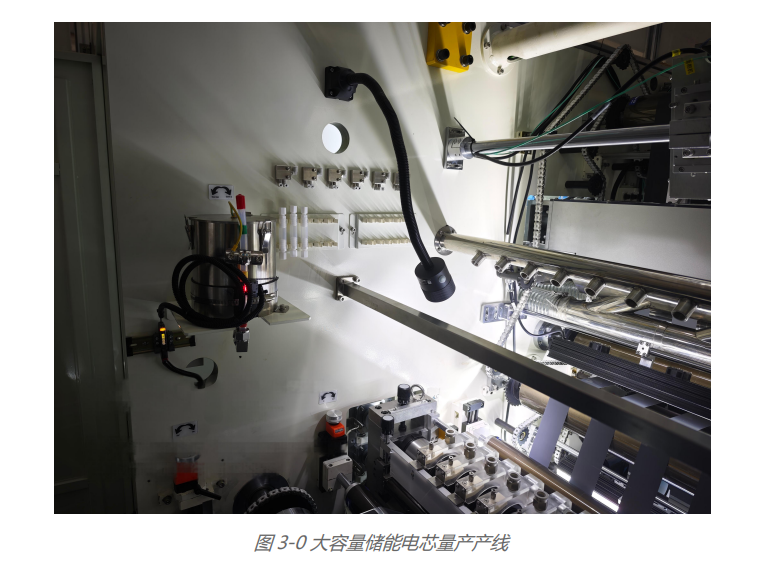
Figure 3-0 Mass production line for large-capacity energy storage cells
(1) 580 Ah+ Generational Switch: Coming Faster Than Expected
The most noteworthy technology development in September is not a particular new product, but that the 500+ Ah generational switch truly entered the "batch delivery" stage: Pylontech mass-produced 588 Ah/601 Ah cells at its Hefei base on September 21, with the first batch of over 100 MWh delivered in batches, supporting PyOcean 6.25 MWh/8 MWh systems; HiTHIUM's ∞Cell 587 Ah was mass-produced in August, with the first shipment from its Texas plant in the U.S. on August 28; Rongjie Energy's 588 Ah continued to ship to leading system integrators; Envision AESC's 790 Ah wound cell was mass-produced in July, with the first batch shipped to Germany; CATL's 587 Ah cell is rated for 12,000 cycles, and it simultaneously started first deliveries of sodium-ion batteries.
2026 "500+ Ah Large-capacity Cell Mass Production Race: From 'Sample' to 'Batch Delivery' in Less Than a Year"
CATL publicly listed 587 Ah at RMB 0.415/Wh—capacity about 87% higher than 314 Ah, price only about 3% higher, per-kWh BOM cost significantly reduced, the number of cells in a pack decreased, and busbars and BMS sampling points reduced accordingly, with system integration BOS costs falling as a result. RMB 0.415/Wh is not a promotional price, but the result of winding/stacking yield, electrode consistency, and formation efficiency working together: it means leading manufacturers have completed the process closed loop and mass production verification for 580 Ah+ and are willing to make this cost level public as a new anchor.
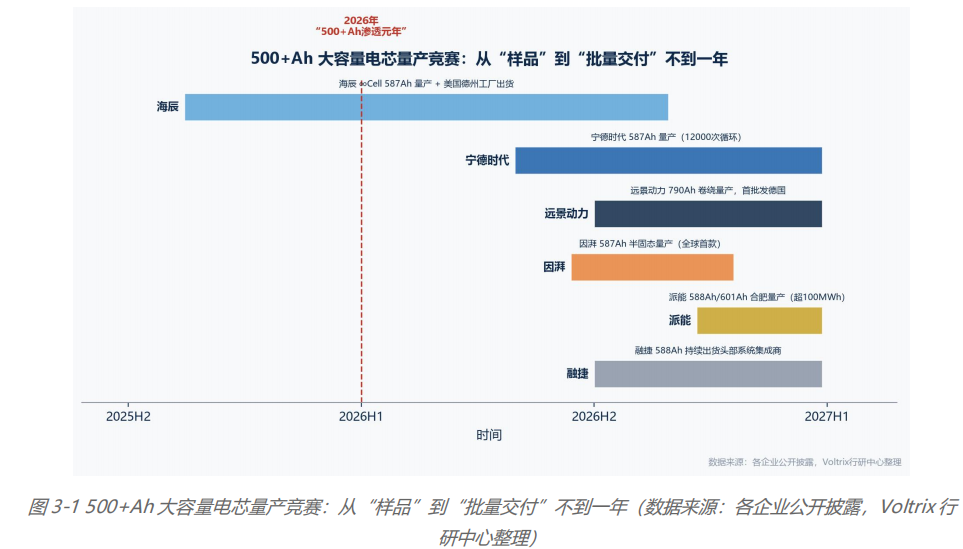
Figure 3-1 500+ Ah large-capacity cell mass production race: From "sample" to "batch delivery" in less than a year (Source: public disclosures of various companies, compiled by Voltrix Industry Research Center)
This anchor is direct pressure on second-tier manufacturers: just as 500 Ah+ production lines have ramped to break-even, the new generation of products shifts the entire price band downward. If they cannot complete 580 Ah+ mass production follow-up within 6 months, existing production lines will face the sunk-cost risk of "being replaced as soon as they are put into production." On the upstream materials side, the volume ramp of 587 Ah will change the demand structure for electrode width, coating areal density, and separator thickness—this is one of the most certain engineering variables in the next stage of the industry chain.
(3) Sodium-ion 20,000 Cycles + National Standards Implementation: From Parameter Competition to Systems Engineering Competition
On September 16, HiTHIUM released its new-generation sodium-ion system PowerN 4.0 MWh, equipped with self-developed N8 and C5 cells, with cycle life rated at 20,000 cycles and a designed service life of 30 years; in the same month, Namitech's 1.5 GWh full-tab large cylindrical production line was put into operation in Bazhong, and it released the 330 Ah "NaJiu" battery. Standards were implemented simultaneously: on August 28, two national standards for sodium-ion energy storage were released—GB/T 48072-2026 "Safety Technical Specifications for Sodium-ion Batteries and Battery Packs for Electrical Energy Storage Systems" and GB/T 48098-2026 "Technical Specifications for Sodium-ion Batteries and Battery Packs for Electrical Energy Storage Systems"—to be implemented on March 1, 2027, unifying procurement and grid-connection acceptance criteria.
From an engineering perspective, 20,000 cycles is not a single material breakthrough, but the convergence of a set of system constraints: cathode material phase-transition stability, electrolyte sodium plating control, anode first-cycle efficiency, and system-level BMS life management, thermal management window, and depth of discharge settings must all match one another. It also reversely affects system design—when cell life is significantly longer than other system components, the life and maintainability of the BMS, liquid cooling units, and fire protection system become new bottlenecks. Sodium-ion batteries are moving from "parameter competition" to "systems engineering competition."
On September 2, ProLogium announced that its third-generation lithium ceramic all-solid-state cell entered mass production, with energy density of 381 Wh/kg and TÜV certification; on September 9, CATL stated it would achieve small-batch production in 2027. Putting the two together, industry expectations for all-solid-state have shifted from "route debate" to "mass production engineering debate."
The gap that needs to be viewed calmly lies in production lines: 381 Wh/kg is a cell-level parameter; after system-level integration, grouping efficiency and safety margin must be considered; the core bottleneck of all-solid-state mass production is not materials, but continuous coating of electrodes and electrolyte layers, stacking alignment precision, and yield ramp-up. ProLogium is currently still at GWh-level pilot testing, at least 2–3 years away from 10 GWh-level economies of scale. In the next three years, the main force of deployment will still be semi-solid-state, and the engineering value of all-solid-state will not truly be realized until around 2028.
Engineering service perspective: what is scarcest during the generational switch is not "making a cell," but "making cells in batches verifiably." 500+ Ah doubles or more the tightening of tolerances for electrode width, areal density, and coating uniformity. Mass production consistency verification, production line FAT acceptance, and batch traceability are becoming the entry ticket for the generational switch—this is precisely the new position of independent third-party engineering technology service providers between production lines and the supply chain.
IV. Industry Chain Dynamics: Cost Discipline and Delivery Engineering Under Lithium Price Revaluation
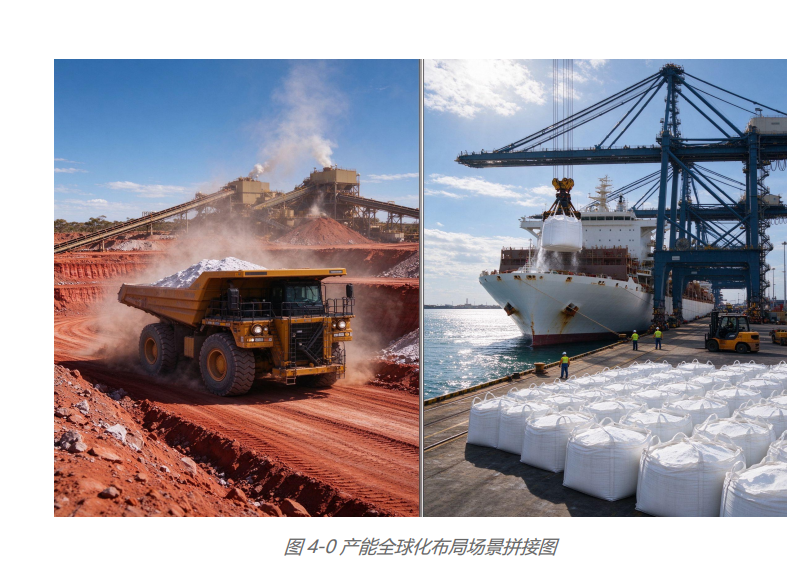
Figure 4-0 Collage of global production capacity layout scenarios
(1) Lithium Price "Not Strong in Peak Season": Loose Supply Rewrites BOM Cost and Inventory Discipline
In September, lithium carbonate prices fell from RMB 157,000/t at the end of August to RMB 120,000/t at the end of September, a monthly decline of about 24%, the largest monthly decline since the second half of 2026; the main futures contract fell below RMB 120,000/t on September 28, hitting a new low for the year, down about 40% from the May high and down 26.45% cumulatively in September. According to past patterns, the Q3 production peak season should support lithium prices, but domestic lithium carbonate production in September was 116,800 t (month-on-month +9.7%), combined with the resumption of production at Australia's Bald Hill mine and Ngungaju concentrator, supply loosened faster than demand grew; the Federal Reserve raised interest rates in mid-September, tightening macro liquidity, and nonferrous metals came under overall pressure, with prices falling below the industry's previous cost support expectations.
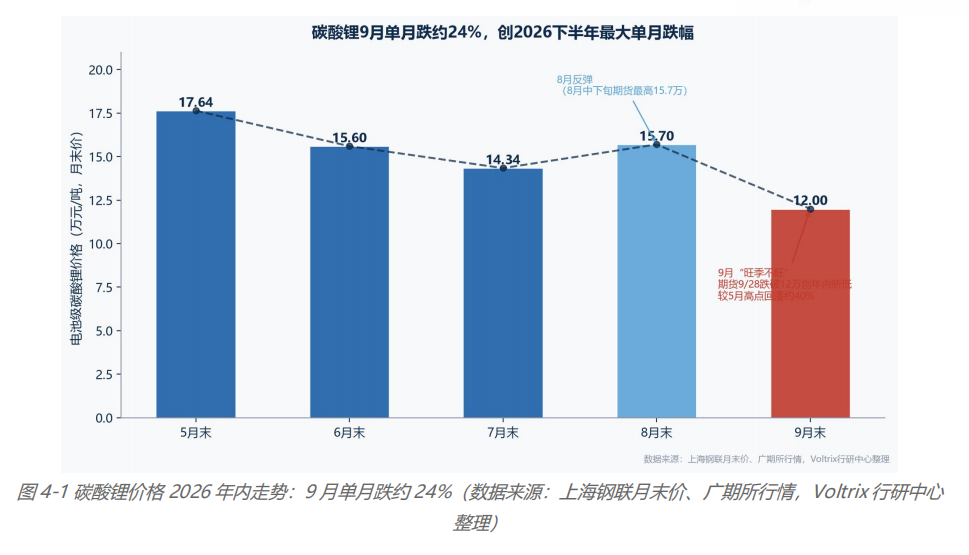
Figure 4-1 Lithium carbonate price trend in 2026: down about 24% in September alone (Source: Shanghai Steel Union month-end prices, GFEX quotes, compiled by Voltrix Industry Research Center)
(2) 206 GWh Long-term Agreement: Pushing the Focus of Competition Toward Delivery Engineering
On the evening of September 17, EVE Energy announced that its subsidiary EVE Power signed a 2027–2031 battery supply framework agreement with Fluence, with a total scale of 206 GWh, including 16 GWh committed delivery in 2027 and 190 GWh reserved capacity for 2028–2031, setting a record for a single framework agreement in the global energy storage industry. The order points to U.S. AIDC energy storage—Guosheng Securities estimates that AIDC storage deployment will drive U.S. energy storage demand increments of 10/27/39 GWh in 2026–2028, and Fluence's data center energy storage pipeline has grown 30% quarter-on-quarter to 12 GWh.
The engineering significance of this order lies in the delivery chain: the deterministic delivery of 16 GWh in 2027 requires locked production capacity planning, upfront overseas certification (UL 9540A, FEOC compliance), and a FAT acceptance system aligned with U.S. integrator standards; the 190 GWh reserved capacity tests the flexibility of expansion pace—order fulfillment depends on specifications, prices, and delivery periods to be finalized case by case later. Chinese companies entering the U.S. market are shifting from "direct export" to "binding with local integrators + long-term frameworks." This model clearly increases demand for third-party engineering services (production line FAT, electrode consistency verification, overseas localized process support)—this is precisely the opportunity window for independent engineering technology service providers.
(3) September Overseas Order Structure: Europe Leads, Regional Thresholds Diverge
In addition to EVE's mega order, in September Sungrow, Trina Storage, WeLion New Energy, and Natong Energy signed a total of over 2.3 GWh of overseas orders, covering Germany, Australia, and Hungary; EVE delivered its first batch of residential energy storage to the Philippines. In September, overseas orders explicitly mentioning energy storage batteries/systems totaled about 18.5 GWh, with Europe leading at over 10 GWh, and the UK, Poland, and Romania becoming new hotspots. Engineering thresholds in different regions are expanding: the EU's new battery law (carbon footprint, recycled material ratio) and CE certification constitute compliance engineering thresholds, while North America is mainly UL/FEOC—overseas companies' certification teams and testing budgets will directly determine the speed of obtaining regional orders.
V. Segment Tracks: Verification Thresholds Determine Track Divergence
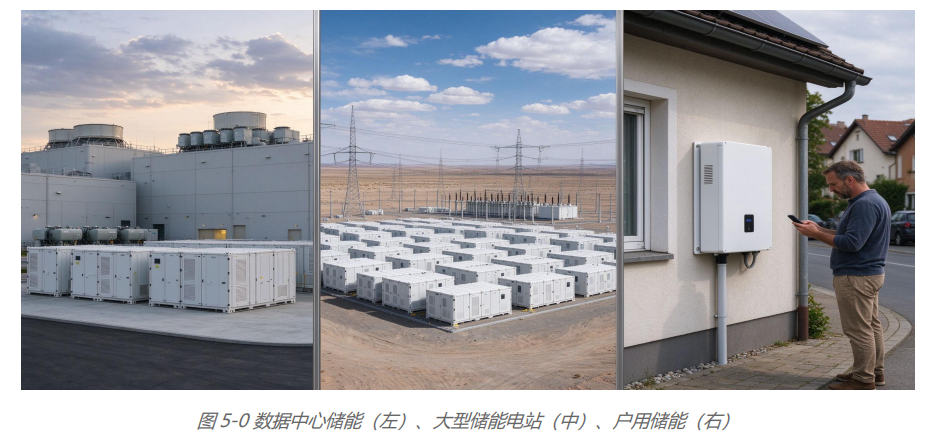
Figure 5-0 Data center energy storage (left), large-scale energy storage station (center), residential energy storage (right)
(1) Grid-side Large-scale Storage: Long-duration Trend Pushes System Design to New Operating Conditions
In the week of September 19–25, national energy storage tendering totaled 15.4 GW/66.8 GWh (tendering 5.7 GW/37.6 GWh, bid opening 9.7 GW/29.2 GWh), with Qinghai's 2 GW/8 GWh and multiple GWh-level EPCs in Inner Mongolia released in a concentrated manner, making the northwest the main battlefield for Q4 tendering. Projects of 4 hours or more accounted for over 55%, and those of 6 hours or more about 20%. The impact of long-duration on engineering is structural: under 4–6 hour operating conditions, PCS capacity configuration, battery cluster series-parallel design, thermal management strategy, and transformer selection must all be checked for long-duration discharge, and system energy throughput and cycle depth become design constraints with higher priority than power density.
(2) AIDC Computing Power Energy Storage: High Threshold, Long Verification, First-mover Lock-in
AIDC is the track with the strongest certainty this quarter, but its threshold is completely different from ordinary large-scale storage: system life of more than 15 years, millisecond-level response, deep adaptation to data center power architecture (diesel generator + UPS + energy storage), and safety redundancy design far exceeding conventional projects. Such projects have long verification cycles and high certification requirements. A 5-year framework agreement means earlier entrants will lock in long-term share, and the window for latecomers is limited. The test for cells and integration lies in consistency and safety engineering, not price.
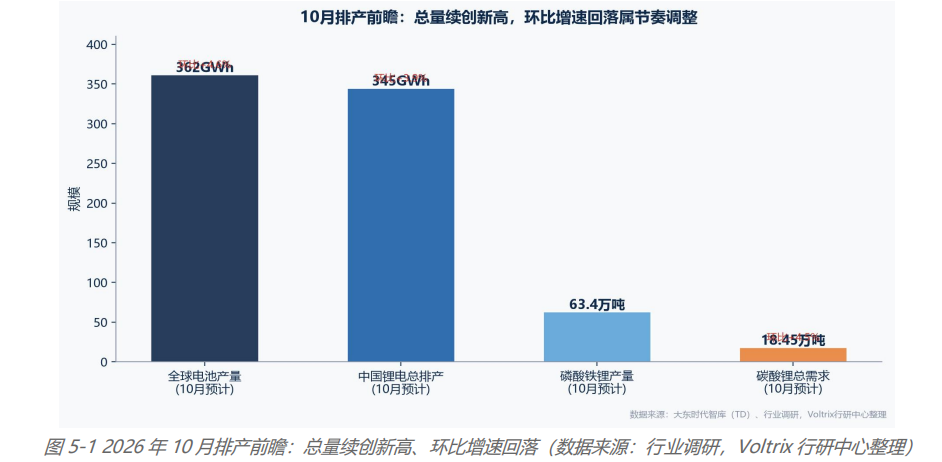
Figure 5-1 October 2026 production schedule outlook: total volume continues to hit new highs, month-on-month growth rate falls back (Source: industry research, compiled by Voltrix Industry Research Center)
Europe's residential storage penetration rate has exceeded 30%, mainly replacement demand; incremental growth is concentrated in off-grid rigid-demand markets such as Southeast Asia, Latin America, and the Middle East. The engineering threshold in these markets is not technology but adaptation: wide voltage range, tolerance to high-frequency grid fluctuations, and compatibility with local grid standards and installation systems. Price sensitivity combined with low brand awareness gives Chinese companies an opportunity to enter, but localized certification and after-sales systems determine how far they can go.
(4) Special Batteries and eVTOL: Steady Progress Under Certification Barriers
The special battery track maintained steady progress in September, eVTOL certification proceeded as planned, and cylindrical batteries' dominance in aviation scenarios remains solid. This track is characterized by slow but steady progress: airworthiness certification cycles are measured in years, and the engineering data accumulation of first movers forms a high barrier. There is no price war pressure in the short term, making it one of the segments with the best profit quality in the lithium battery industry chain.
VI. Capital and Trade: Safety Incidents Revalue Quality Weight; Capital Prices Engineering Capability
(1) Primary Market: Investment Direction Shifts from Capacity to Delivery Capability
In September, primary-market energy storage financing continued to concentrate toward leaders, with industrial capital still the main force, and the direction clearly shifting from domestic system integration to overseas services, overseas localized operations, and cross-border supply chains. The essence of this shift is that capital is pricing "delivery capability"—domestic large-scale storage price competition is white-hot and profits are narrowing, while targets with overseas certification, localized teams, and engineering service capabilities are gaining valuation premiums.
(2) Secondary Market: Sector Divergence Amid Lithium Price Fluctuations
In September, the lithium battery energy storage sector was highly correlated with lithium prices: in the initial stage of the lithium price plunge, the market worried about midstream inventory impairment, and the sector pulled back as a whole; after lithium prices stabilized near RMB 120,000, the market reassessed the benefits of falling costs for cells and integration. Companies with cost control capabilities and high overseas revenue shares performed relatively firmly, while upstream companies relying on lithium mineral resources came under obvious pressure—this round of divergence is essentially the market repricing "who has engineering cost advantages."
(3) Three Energy Storage Fires in Four Days: Safety Verification Moves from Optional to Entry Threshold
In the early morning of September 18, the Moss Landing energy storage station in California, U.S., caught fire again, its fifth accident in five years. The ignition point was located at the north wall of the Moss 300 facility damaged by a major fire in 2025, where about 1,200–1,500 still-charged battery modules remained and spontaneously combusted; the area was equipped with Korean cells; by September 19, open flames and smoke had been eliminated and the natural gas plant resumed operation, and the cause of the accident is still under investigation. On September 21, the energy storage facility at KEPCO's Daejeon Research Institute in South Korea caught fire, with all 28 battery packs lost and nearly 4 hours needed to extinguish it; on September 22, the energy storage facility of the La Verne water district in California, U.S., caught fire, and nearby residents were evacuated. With three fires in four days in the U.S. and South Korea, safety incidents have entered a high-incidence period.
The lessons at the engineering level are structural: thermal runaway propagation path control, fire protection system response window, and BMS early warning logic—defects in any link will be amplified by scale. The Moss Landing accident occurred in a legacy damaged area rather than a newly operating system, but the governance gap exposed by the prolonged post-disaster cleanup has elevated energy storage safety from a technical issue to a public issue; California is already drafting stricter energy storage safety regulations, and if more regions follow suit, design standards for fire separation distances, cluster-level protection, and early warning linkage will be upgraded across the board, directly pushing up system costs—safety investment is moving from optional to an entry threshold.
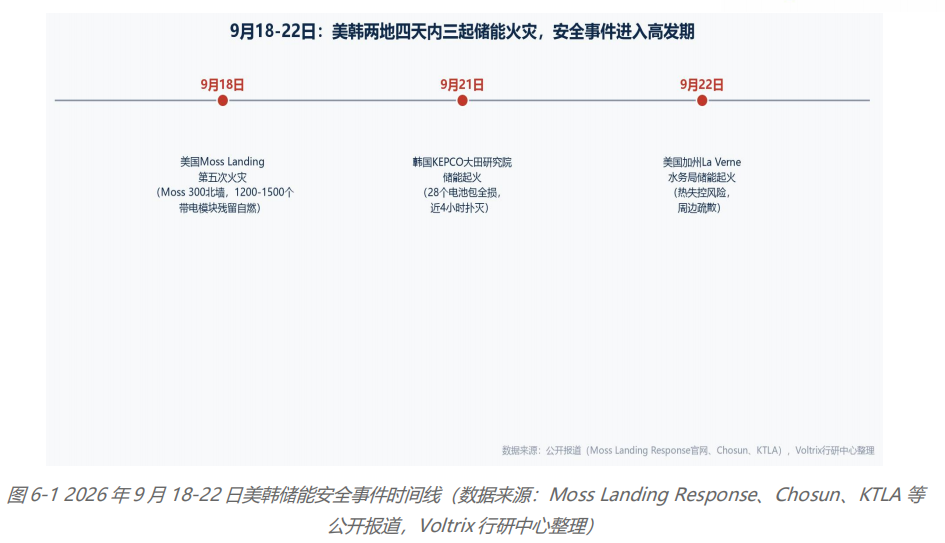
Figure 6-1 Timeline of U.S.-South Korea energy storage safety incidents, September 18–22, 2026 (Source: Moss Landing Response, Chosun, KTLA and other public reports, compiled by Voltrix Industry Research Center)
VII. Comprehensive Industry Prosperity Judgment (PISTER) and Next Month's Observation Indicators
(1) PISTER Six-dimension Comprehensive Prosperity Score
Based on the PISTER six-dimension framework, the September comprehensive prosperity index was 8.90, down 0.10 from 9.00 in August. The decline was concentrated in the supply chain (inventory impairment concerns triggered by the lithium price plunge) and investment (sector pullback) dimensions; policy, technology, and segment tracks remained at high levels. The industry as a whole is still in a high-prosperity range, but the structural pressure behind "falling prices with rising volumes" needs continuous tracking—October is a key window to test the quality of "volume growth."
Table 7-1 PISTER Six-dimension Comprehensive Prosperity Score
| Dimension | September | August | Change | Core Basis |
|---|
| Policy | 9.3 | 9.4 | ↓ | Document No. 1077 settlement engine launched, detailed rules landed in multiple provinces, but implementation divergence emerged |
| Technology | 9.0 | 8.9 | ↑ | 587 Ah publicly listed and priced, sodium-ion 20,000 cycles, all-solid-state mass production milestone |
| Supply Chain | 8.7 | 9.0 | ↓ | Lithium price fell about 24% in a single month, inventory impairment pressure, supply loosening exceeded expectations |
| Segment Tracks | 9.0 | 9.1 | ↓ | Large-scale storage tendering accelerated, long-duration trend strengthened, cost pass-through diverged during price recovery cycle |
| Investment | 8.5 | 8.6 | ↓ | Sector pulled back with lithium prices, primary market concentrated toward overseas expansion and delivery capability |
| Environment | 8.9 | 9.0 | ↓ | High export growth continued, but trade barriers and safety incidents increased uncertainty |
| Comprehensive | 8.90 | 9.00 | ↓ | Slight pullback within a high-prosperity range, structural pressure emerged |
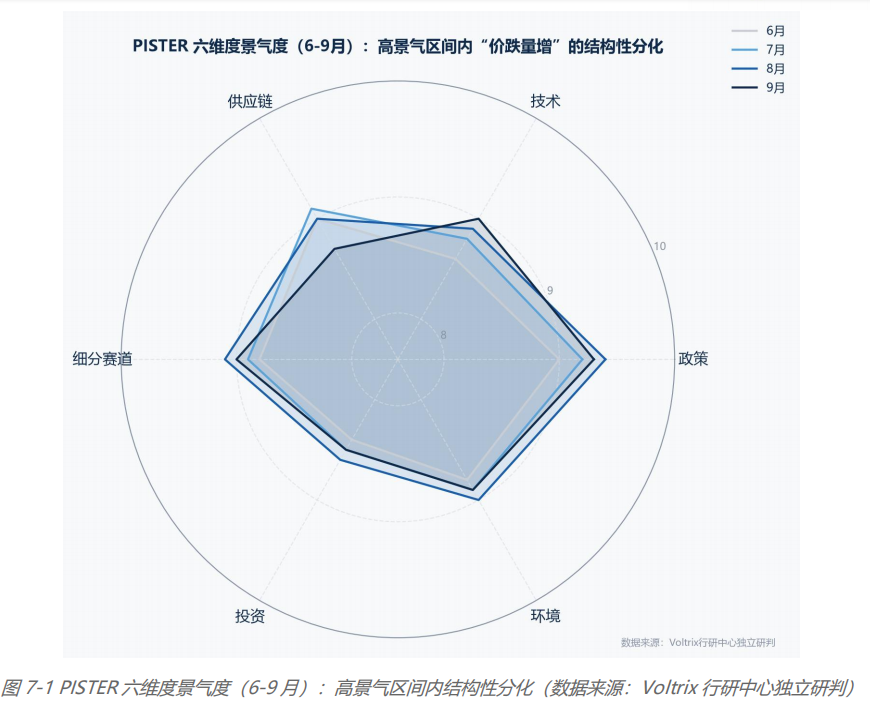
Figure 7-1 PISTER six-dimension prosperity (June–September): Structural divergence within a high-prosperity range (Source: independent judgment by Voltrix Industry Research Center)
(2) Core Observation Indicators for Next Month
October will focus on six groups of engineering indicators: first, whether lithium prices can stabilize near RMB 120,000/t—the inversion of outsourced mining costs provides a floor, but tightening macro liquidity and pessimistic long-term expectations remain downward variables; Dadong Times Think Tank (TD) estimates global battery production in October at about 362 GWh, month-on-month +4.6%, China's total lithium battery market production schedule at about 345 GWh, month-on-month +3.9%, LFP production in October at 634,000 t, and total lithium carbonate demand in October at 184,500 t, month-on-month +4.5%; second, the actual implementation scale of Q4 large-scale storage tendering and the share of projects of 4 hours or more; third, order conversion after the 587 Ah listing and the pace of second-tier price following; fourth, execution details of the 206 GWh framework—certification progress, production schedule lock-in, and the pace of subsequent case-by-case order finalization for the 16 GWh commitment in 2027; fifth, safety regulation trends in California and other countries after the U.S.-South Korea energy storage fires; sixth, production line utilization and consistency data for sodium-ion mass production and delivery (two national standards for sodium-ion energy storage have been released and will be implemented in March 2027).
VIII. Risk Warnings: Marginal Variables from an Engineering Perspective
The following five types of risk are the reverse variables most worthy of vigilance in this month's judgment, all unfolded from the engineering and delivery dimensions.
(1) Inventory and Long-term Agreement Risks from a Larger-than-expected Lithium Price Decline
Lithium prices fell about 24% in September alone, exceeding widespread market expectations. If prices continue to fall below RMB 100,000 in October, it will trigger a chain reaction of concentrated midstream material inventory impairment, upstream production cuts, and renegotiation of cathode material long-term contracts; conversely, if a shift in macro liquidity and completion of destocking drive a price recovery, the impairment pressure on previously high-priced inventory will also ease. For corporate engineering management, violent fluctuations are more dangerous than high or low prices—without establishing stable cost calculations and long-term contract pricing, project feasibility studies and order quotations will both be distorted.
(2) Production Line Sunk-cost Risk Under the 587 Ah Generational Switch
587 Ah is listed at RMB 0.415/Wh, offering nearly twice the capacity at a similar unit price, directly squeezing second-tier manufacturers still ramping 500 Ah+ yield. If they cannot complete 580 Ah+ mass production follow-up within 6 months, existing production lines will face the sunk-cost risk of "being replaced as soon as they are put into production," and capacity utilization and cash flow will come under simultaneous pressure; in a price-recovery cycle, small and medium-sized manufacturers with weak cost pass-through ability will instead see their profit space compressed.
(3) Schedule Risk of Overseas Certification and Compliance Engineering
The enforcement scale of the EU's dual mandatory compliance on October 1 and CBAM's first-year verification is undetermined, U.S. FEOC rules continue to be refined, and overseas certification cycles may be longer than order delivery expectations. Among them, the time required to pass carbon footprint MRV and cybersecurity type certification is highly dependent on third-party verification agency schedules and supply chain data completeness—certification delays will directly block delivery nodes. This is a hard constraint at the engineering level that cannot be covered by commercial terms.
(4) System Cost Risk from Upgrading Energy Storage Safety Regulations
If the three energy storage fires in the U.S. and South Korea in four days push California and even the entire U.S. to tighten safety regulations (fire separation distances, cluster-level protection, early warning linkage), it will raise system design and construction costs across the board; if imitated by many countries, overseas companies' product iteration costs will further increase.
(5) Execution and Fulfillment Pace Risk of AIDC Long-term Agreements
The long-term demand certainty for AIDC energy storage is relatively strong, but the short-term fulfillment pace is uncertain: adjustments in global AI capital expenditure or delays in data center construction will lengthen the demand release cycle, and the deterministic delivery portion in long-term agreements may be postponed, tying up expansion capital expenditure.
IX. Core Data Comparison Table and Disclaimer
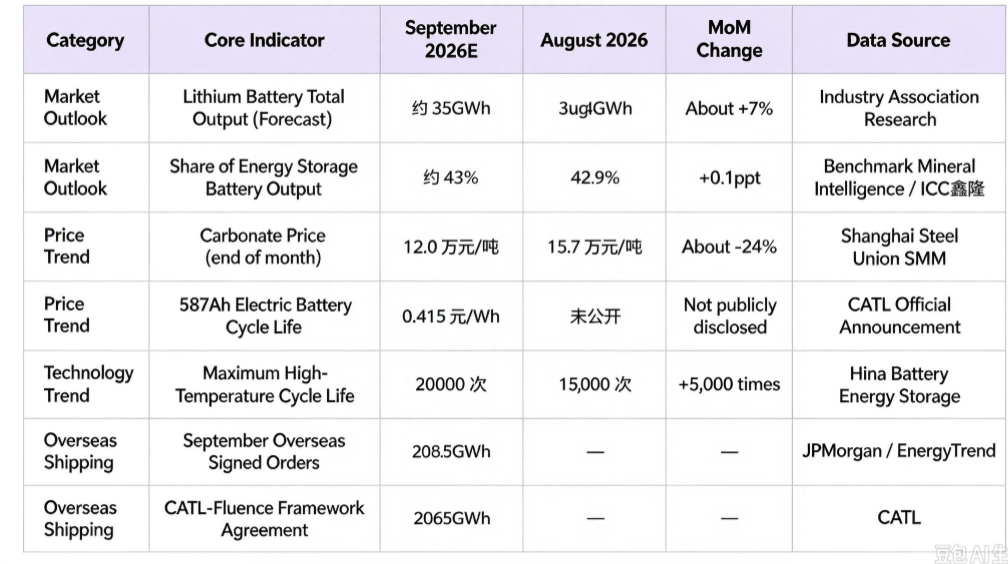
(1) Core Data Comparison Table
(1) This report was independently written by Voltrix Industry Research Center based on publicly available authoritative information and first-line industry research. It is a neutral industry technical research output, does not involve commercial product promotion, and does not constitute investment or business decision advice.
(2) Data cited in the report come from official institutions, industry associations, and public disclosures by companies, and copyright belongs to the original institutions; judgment conclusions represent only the views of the Industry Research Center.
(3) This report is for exchange and reference only, and our center assumes no responsibility for any direct or indirect losses incurred by any entity as a result of using the content of this report.
(4) The copyright of this report belongs to Voltrix Industry Research Center; reproduction and citation require attribution to the source.
9.3 About Us
Voltrix Industry Research Center focuses on first-line implementation research in the lithium battery energy storage industry. Leveraging an engineering-oriented industry perspective, it produces in-depth, objective, and actionable industry research content. The center always maintains a neutral third-party research stance.
Data update cycle: monthly rolling update, establishing a continuous and comparable indicator tracking system. Next report release date: November 5, 2026.
© 2026 Voltrix Industry Research Center. All rights reserved.