Amidst intensifying global energy and political games, accelerated electrification, and the explosion of AI technology, electricity is becoming one of the world's most critical energy assets. With the deepening global consensus on carbon neutrality, new energy power, primarily wind and solar, has entered an epic growth cycle. Energy storage has thus become the decisive key to solving the consumption challenge of new energy and determining the outcome of the global energy transformation.
I. The Global Energy Storage Market is Surging
As new energy sources like wind and solar rise powerfully, consumption has become the most severe challenge in the industrialization process, leading to an explosive growth in energy storage.
Surge in Installed Capacity: According to authoritative data, from 2020 to 2025, the global annual newly installed capacity of new energy storage skyrocketed from 13 GWh to 306 GWh, a more than 23-fold increase. The Chinese market, in particular, saw a dramatic rise from 3 GWh to 190 GWh, an increase of over 62 times.
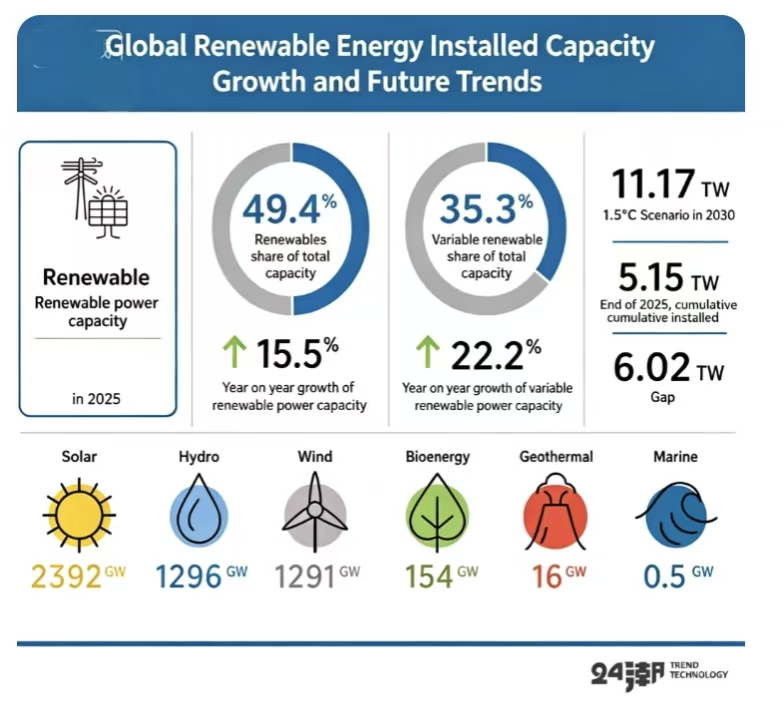
Vast Future Growth Potential: Minmetals Securities analysis suggests that the peak of annual newly installed capacity for global wind-solar-storage (large-scale storage) is expected around 2035, potentially exceeding 1.5 TWh. This indicates approximately 8.6 times more growth potential from current levels to the installation ceiling. The compound annual growth rate (CAGR) for global new energy storage installations from 2024-2035 is projected to be around 21.3%.
II. Residential Energy Storage: Low Penetration, Vast Prospects
The residential energy storage market currently has a very low penetration rate but holds immense future potential.
Market Potential Estimation: CITIC Securities analysis believes that considering factors like high electricity prices and villa power demand in developed countries, as well as power shortages in emerging markets, the long-term cumulative global residential storage installation could reach 2842 GWh.
Current Penetration Rate: By the end of 2025, the cumulative global residential storage installation was approximately 79 GWh, with a penetration rate of only about 2.8%.
Market Space by Country: In terms of national development potential, China is the only country with a residential storage market space exceeding one trillion RMB, with a potential of 1.61 trillion RMB. The United States follows with 855 billion RMB, and Japan ranks third with 236.2 billion RMB.
III. Commercial & Industrial (C&I) Storage: Greater Growth Potential
Compared to residential storage, global C&I energy storage is considered to have even greater growth potential, driven by two main factors:
Improving Electricity Market Mechanisms: Countries with a high proportion of green electricity are gradually refining their electricity market mechanisms. By leveraging peak-valley price differences and ancillary services, they are enhancing the economics of C&I storage, stimulating demand to alleviate grid pressure.
Surging Demand from High-Consumption Scenarios: The growing power supply-demand gap in high-energy-consumption scenarios like AI data centers and mining areas is prompting C&I owners to increase their proportion of self-equipped energy storage.
CITIC Securities estimates that the long-term cumulative installed capacity of global C&I storage will exceed 4592 GWh, with a market space of approximately 4.7 trillion RMB. By the end of 2025, its penetration rate was less than 1%.
IV. Emerging Application Scenarios Spawn Massive Demand
With the fission of global application scenarios, energy storage demand is no longer limited to the traditional "source-grid-load." New scenarios like computing centers, ultra-fast charging networks, and off-grid microgrids are generating massive incremental demand.
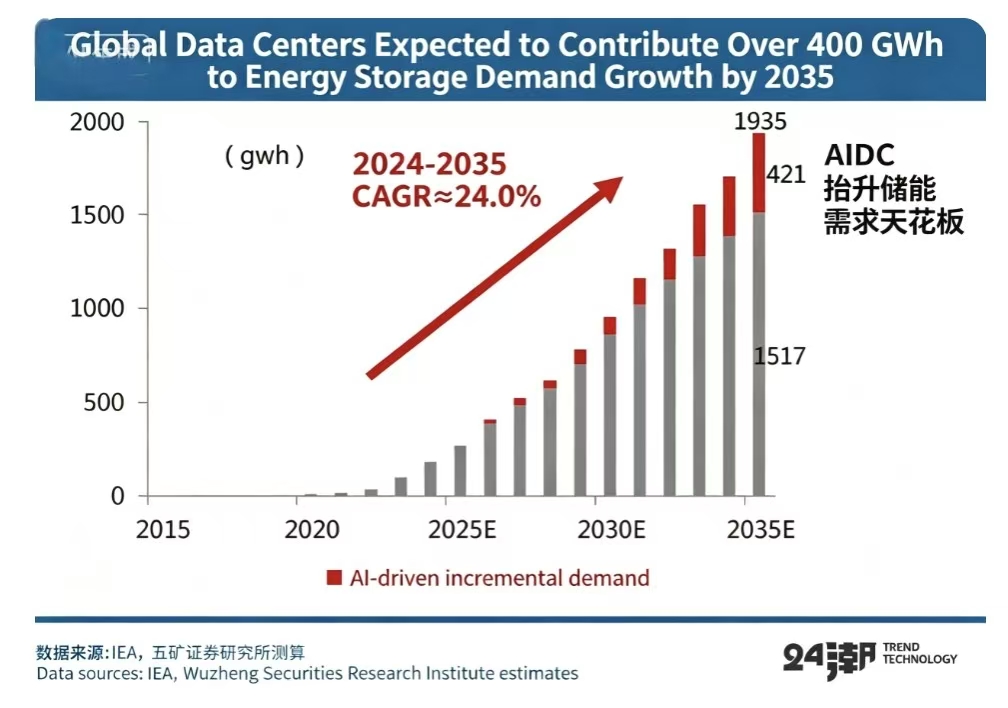
AI Data Centers (AIDC): AI data centers have high power density, drastic load fluctuations, and stringent reliability requirements. In NVIDIA's released 800V high-voltage DC power supply architecture, energy storage is expected to become a standard configuration for the new generation of power supply architectures. The IEA predicts that by 2030, the total global scale of data centers could reach 226 GW. Minmetals Securities calculates that the incremental storage demand from AI could raise the CAGR of storage demand from 21.3% to 24.0% for 2024-2035.
Off-grid Microgrids: Demand for energy storage in microgrid scenarios such as mines, oilfields, salt lakes, and islands is continuously increasing. Market.us forecasts that the global microgrid battery energy storage market will grow from $21 billion in 2024 to $8.9 billion in 2034.
Ultra-fast Charging Networks: Along with the global electrification of vehicles, a huge energy storage demand is hidden within fast-charging networks. It is estimated that if 10% of global public charging piles are retrofitted with integrated storage-charging, it would release nearly 260 GWh of energy storage demand.
V. Outlook on the Future Competitive Landscape
In the future, companies with the following characteristics are more likely to assume a leading position in the new energy storage order:
A profound understanding of global power systems and all application scenarios.
Full-stack self-research and development capabilities in key hardware, software, and even the entire energy storage system.
Extensive practical experience on a global scale.
Sustainable operational capabilities.
In the long run, the global energy storage industry is far from its endgame, and more exciting stories are yet to unfold.
References & Acknowledgments