【Content Summary】 This month, China's lithium battery and energy storage industry has officially entered a strong cyclical phase driven by storage dominance, technology breakthroughs, price recovery, profit realisation, accelerated global expansion, and structural reconfiguration. The industry's growth logic has completed a historic shift. It has thoroughly moved away from the past two years of overcapacity and low‑price involution, forming a triple‑core driver: "energy storage as a rigid underpinning, AI data centre backup power as an incremental addition, and overseas energy security as a supplementary imperative." Energy storage has far surpassed power batteries to become the primary growth curve of the lithium battery industry, with the structural transformation fully materialising.
1. Core Market Dynamics | Core Market Dynamics
1) Production & sales structure restructured, energy storage secures absolute dominance
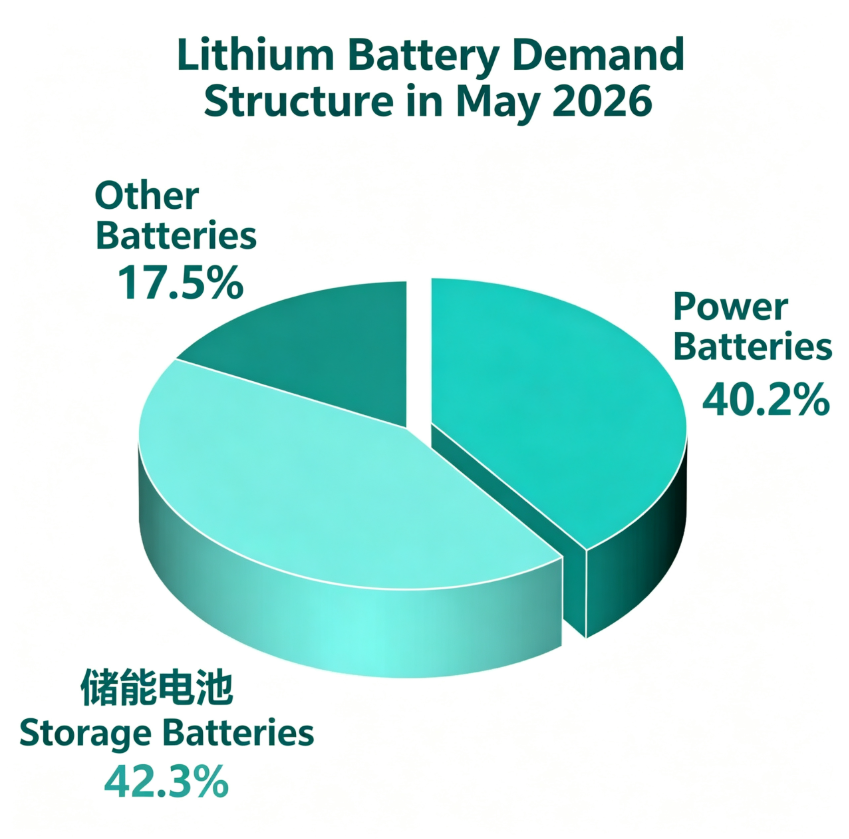
In May 2026, the total production scheduling of all lithium‑battery categories (energy storage, power, consumer) in China reached 249 GWh, up 6% month‑on‑month, marking the third consecutive month of record highs, with the industry operating at a sustained high level of activity. The category mix underwent a historic reversal: energy storage cells officially replaced power batteries as the largest segment, accounting for 42.3% of total production, corresponding to about 105 GWh; traditional power battery scheduling fell to 41.0% (~102 GWh), with its market share continuing to shrink; NCM cells accounted for only 14.7%, a new low for the year; consumer and other batteries made up 2.0%. In terms of global supply, total global lithium battery production reached about 262 GWh, with China's capacity accounting for over 95%, firmly controlling the supply dominance of the global lithium battery and energy storage industry.
2) Market shipments grow at high speed, small‑scale storage leads sector growth
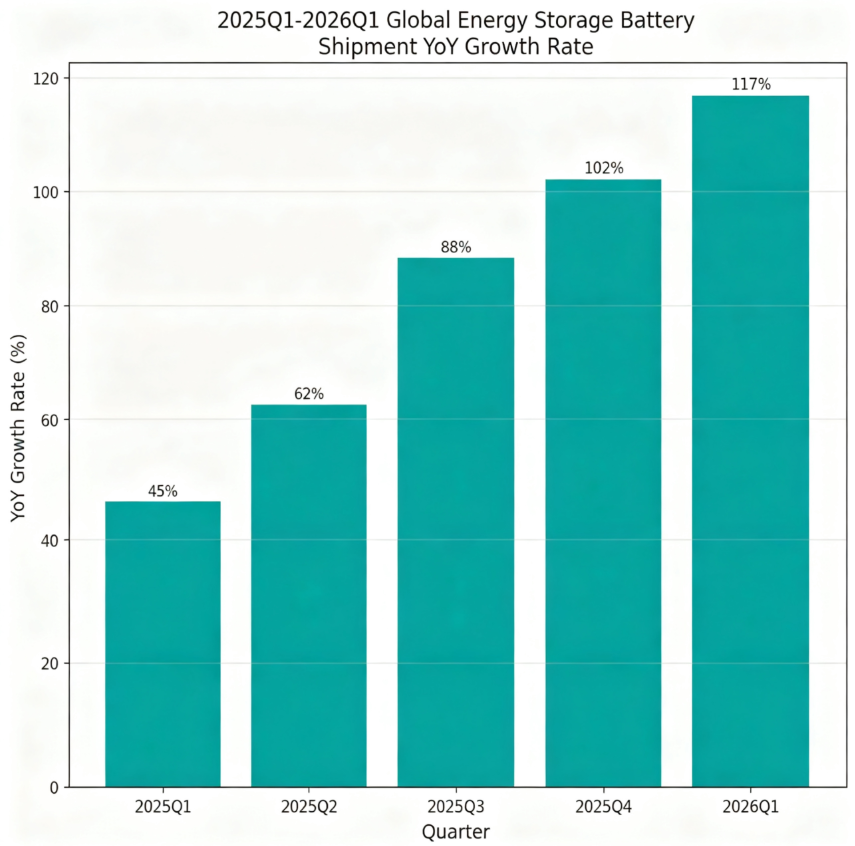
In Q1 2026, global energy storage cell shipments totalled 205.52 GWh, a sharp year‑on‑year increase of 98.70% and a slight month‑on‑month increase of 1.62%, maintaining high growth in the global storage market. Sub‑segment differentiation is obvious: utility‑scale storage remains the core market, with Q1 shipments of 178.27 GWh, up 84.54% YoY, supporting grid‑scale storage and large wind‑solar storage projects; small‑scale storage (residential + small‑to‑medium commercial & industrial) experienced explosive growth, with shipments of 27.25 GWh, a staggering 298.98% YoY increase and 55.27% MoM growth, with the European residential storage market becoming the primary incremental source.
Domestic energy storage tendering activity is unprecedentedly hot. From January to April 2026, cumulative tenders for energy storage systems in China reached 105.73 GWh, up 132% YoY, with demand continuing to expand. The short‑term tender volume in early May alone surpassed the entire 2025 total. Utility‑scale, commercial & industrial distributed, and residential storage all saw simultaneous volume growth, confirming a clear high‑prosperity outlook.
3) Full‑chain price recovery, raw material prices rise significantly
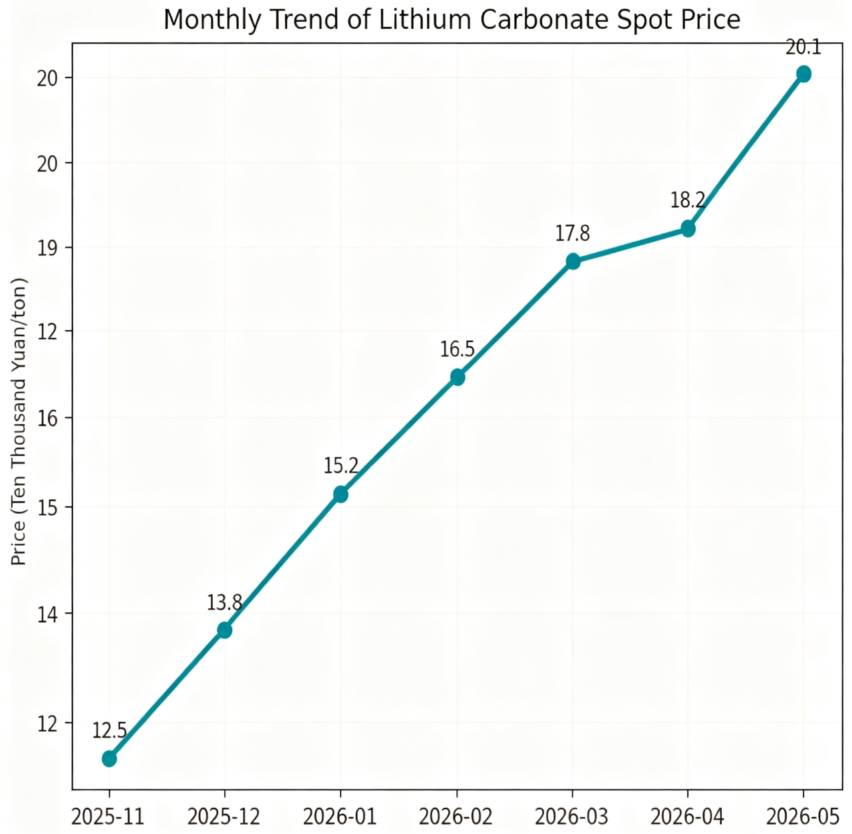
[Image] In May, prices across the lithium‑storage industry chain rose across the board, with raw material increases transmitting downstream to cells and systems. The mainstream spot transaction price of lithium carbonate remained at RMB 175,000–180,000/tonne as of 29 May, having briefly exceeded RMB 200,000/tonne during the month, with a monthly increase of 30% and a cumulative year‑to‑date increase of over 200%. Cell prices followed suit, with mainstream 314Ah LFP cells quoted at RMB 0.40‑0.45/Wh, a monthly increase of 25%‑35%. Centralised procurement prices for storage systems rose 12% month‑on‑month, while terminal prices for commercial & industrial storage all‑in‑one units recovered to RMB 0.8‑0.9/Wh.
From the supply side, Zimbabwe's lithium ore export ban, increased transportation costs for South American lithium ore, and the suspension and permit renewal of some domestic major lithium mines have caused a temporary contraction in upstream lithium supply. On the demand side, explosive growth in the storage market, combined with a recovery in the power battery market and concentrated downstream replenishment, jointly drove the strong rebound in lithium prices. We believe this is not a short‑term spike but the result of supply‑demand resonance. Lithium prices will remain high in the short term until domestic lithium mine resumption is completed.
Price increases in the midstream materials sector were even more pronounced. The core electrolyte raw material, lithium hexafluorophosphate, surged to RMB 120,000‑130,000/tonne, up over 37% month‑on‑month; LFP cathode material prices doubled year‑on‑year to RMB 64,300/tonne; other auxiliary materials such as electrolyte, copper foil, separator, and anode materials also saw tight supply and price adjustments, leading to a systematic restoration of profitability across the industry chain.
4) Policy system continues to improve, market‑oriented profit cycle takes shape
The commercialisation system for domestic energy storage is maturing, with capacity tariff mechanisms now fully implemented nationwide. On 28 May, Shandong Province introduced a major new policy encouraging existing PV installations to voluntarily pair with storage, requiring all additional storage in red zones to be self‑consumed, thereby fully activating the distributed PV‑storage market. Energy storage stations have now formed a triple stable revenue model: "capacity compensation + peak‑valley arbitrage + grid ancillary services," with project IRR steadily maintained at 6%‑12%, completely breaking away from policy dependence and achieving a market‑oriented profit cycle. Complementary industrial policies have also been implemented: the new Interim Measures for the Recycling and Comprehensive Utilisation of Waste Power Batteries from New Energy Vehicles officially took effect, the Extended Producer Responsibility (EPR) system is now fully enforced, and special subsidies for cascade utilisation and resource recycling are in place, regulating the industry's end‑of‑life recovery system.
Overseas policies continue to empower exports. The US IRA Act's safe harbour provisions have been implemented, spurring the start of construction on gigawatt‑hour‑scale storage projects. Europe continues to expand its domestic storage installations to ensure energy security, accelerating the substitution of storage for traditional energy. The EU CBAM carbon tariff has officially come into effect, forcing Chinese lithium‑storage companies to optimise their full‑lifecycle carbon footprint management and driving green, low‑carbon upgrades. With policy dividends coupled with market demand, the industry has completely shaken off low‑price involution, and volume‑price synergy is driving a substantial recovery in corporate earnings.
2. Energy Storage: Global Growth Engine | Energy Storage: Global Growth Engine
1) Global installed capacity steadily expands, differentiated growth between Chinese and overseas markets
As the world's core storage market, China's cumulative installed capacity of new energy storage reached 144.7 GW by the end of 2025, accounting for 51.9% of the global total, firmly ranking first worldwide. Based on industry research, new domestic energy storage installations in 2026 are expected to reach 300 GWh, up 59% YoY, with utility‑scale, C&I distributed, and residential storage all developing rapidly, marking a full‑scale boom period.
The global storage market maintains high growth, with 2026 projected deployments of 158 GW / 459 GWh, up 41% YoY. Regional growth patterns vary significantly: the US, driven by the AI data centre construction boom, sees surging storage demand, with expected new installations of 70‑75 GWh; Europe, driven by energy security reserves and residential storage penetration, adds 30 GWh; Australia sees concentrated deployment of large PV‑storage integrated projects, adding 10 GWh; and emerging markets in the Middle East, Latin America, and Southeast Asia are accelerating storage project implementation, broadening the global growth landscape.
2) Demand structure iterates and upgrades, three main directions established
[Image] Storage product structures are undergoing comprehensive iteration, with ultra‑large‑capacity cells becoming standard for utility‑scale projects. Mainstream products such as CATL's 587Ah, EVE Energy's 628Ah, and REPT Battero's 588Ah have achieved commercial deployment at the gigawatt‑hour level. Large‑capacity cells significantly reduce the number of system components by up to 30%, effectively lowering BOS costs. The industry's storage system platform has upgraded from the traditional 5MWh to 6MWh, increasing site energy density by 20% and greatly improving system economics.
Long‑duration storage has become a key development direction, with installations for projects of 4 hours or more rising to 45% of the mix. To address pain points such as the difficulty of integrating renewable generation, excessive grid peak‑valley differences, and insufficient peak‑shaving capacity, technology routes like flow batteries and sodium‑ion batteries are accelerating penetration, effectively filling the gaps of conventional short‑duration lithium‑ion storage. In addition, AI computing power storage has emerged as a new high‑value segment. Data centre power ratings reach the megawatt level, with storage supporting a 1:1 ratio. Global AI data centre storage demand in 2026 is expected to reach 50 GWh, up 200% YoY, with project IRR exceeding 15%, far outpacing traditional storage projects.
3) Overseas residential storage booms, highlighting the competitive advantages of Chinese products
The European residential storage market continues to thrive, with regional penetration exceeding 30%. In May 2026, regional orders grew 120% YoY, and shipments of matching PV inverters and storage all‑in‑one units rose over 50% month‑on‑month. On the product side, 400V and above high‑voltage integrated storage products have become mainstream, with unit capacities concentrated in the 5‑10kWh range and cycle life exceeding 6,000 cycles. PV‑plus‑storage integrated home systems have become the standard configuration for European households.
Chinese storage products are globally competitive, with domestic brands holding over 60% of the global residential storage market share. Companies such as EVE Energy, REPT Battero, Great Power, and Chuangneng New Energy consistently rank among the top five global shippers. The competitive landscape is dynamic, with the top three (CR3) alternating monthly, while the overall pattern shows concentration at the top with second‑tier players catching up.
3. Technology Iteration: Industrialization Acceleration | Technology Iteration: Industrialization Acceleration
1) Ultra‑large‑cell industrialisation lands, industry bids farewell to the small‑cell era
This month, the technology iteration towards large‑capacity storage cells has entered its final deployment phase. 587Ah and 588Ah ultra‑large‑capacity cells have become the mainstream mass‑production specifications, with 392Ah cells serving as a transitional product, mainly for overseas customer validation and small‑batch project needs. With the cell specification upgrade, storage system architecture continues to be optimised, overall energy density has greatly increased, and system costs continue to decline.
In terms of capacity and cost, large‑capacity cells above 500Ah are expected to achieve mass shipments in Q3 2026, with annual shipment volumes depending on production line yield ramp‑up. Once the production yield reaches the industry standard of 95%, the unit cost of large‑capacity cells is expected to be 10%‑15% lower than traditional 314Ah cells, offering significant cost advantages, with full replacement anticipated by 2027.
Our technical team has completed full‑chain adaptation of the large‑cell process—from material selection, structural design, to manufacturing and testing—ensuring technical synergy and optimisation across all steps. In terms of design and engineering capabilities, including R&D innovation, process validation, and mass‑production readiness, everything is fully prepared and rigorously assessed, ready to respond to customer needs for product upgrades and market breakthroughs at any time.
2) Sodium‑ion battery breaks through inflection point, full‑scale commercialisation underway
Sodium‑ion battery technology continues to improve in performance, driven by innovations in cathode/anode materials, electrolytes, and cell architecture. Currently, these batteries can operate stably over an ultra‑wide temperature range of ‑40°C to 70°C, with the wide‑temperature performance achieved through optimised electrode interfaces and low‑temperature electrolyte formulations. They retain up to 90% of capacity in extreme cold conditions, perfectly suiting storage projects in northern China and high‑latitude overseas regions. Meanwhile, mass‑produced cells have achieved an energy density of 175 Wh/kg and a cycle life exceeding 5,000 cycles, fully meeting commercial standards for storage and low‑speed power applications. With high cost‑effectiveness and environmental advantages, and as large‑scale production ramps up, sodium‑ion batteries will further reduce costs, supporting global energy transition.
A milestone breakthrough in commercialisation: CATL and Hyperstrong signed the world's largest sodium‑ion battery storage order of 60 GWh over 3 years, with a corresponding 40 GWh production capacity planned for formal mass production in Q4 2026. Application scenarios form a dual‑driven pattern: in the storage sector, annual installations are expected to reach 20 GWh, leveraging low cost and cold tolerance to rapidly replace lead‑acid and some lithium batteries; in low‑speed power, covering electric forklifts, AGVs, and low‑speed EVs, annual shipments are projected at 15 GWh, with unit costs expected to fall below RMB 0.3/Wh. The complementary lithium‑sodium industrial application pattern has now taken shape.
3) Solid‑state batteries roll out in phases, industrialisation pace accelerates
The solid‑state battery industry shows a pattern of large‑scale commercialisation of semi‑solid and countdown to mass production of all‑solid. Semi‑solid technology is the most mature, having been deployed in large storage projects in Xinjiang, Shandong, Guangdong, and other regions, with significantly improved safety compared to traditional liquid batteries and reduced thermal runaway risks. Current production costs of semi‑solid cells are 20%‑30% higher than liquid cells, but as capacity expands and yields improve, costs will continue to decline, with total shipments in 2026 expected to reach 10 GWh.
R&D and mass‑production preparation for all‑solid‑state batteries are progressing steadily, with continuous breakthroughs in technical barriers. CATL's Kirin Condensed Battery is planned for formal mass production in the second half of 2026, with cell energy density reaching 350 Wh/kg; Gotion High‑tech's Jinshi series all‑solid‑state battery is expected to begin small‑batch trial production by year‑end, with cycle life exceeding 3,000 cycles, leading the industry in comprehensive performance. In this cutting‑edge field, our production line design and R&D capabilities have also been proactively deployed, preparing for future mass production and enabling clients to seize early opportunities in frontier technologies.
4) PV‑storage technology breakthrough: perovskite solar cell efficiency sets new world record
On 28 May, the PV industry witnessed a milestone technological advancement—certified by international authoritative testing institutions, the laboratory conversion efficiency of perovskite solar cells has broken through 26.81%, once again setting a new world record for the efficiency of such cells. This breakthrough not only signals the maturation of perovskite PV technology but also opens new space for overall efficiency improvement in integrated PV‑storage systems.
Currently, many domestic and international companies have deployed pilot lines for perovskite. With continued optimisation of stability and large‑area fabrication processes, this technology is expected to be gradually industrialised within three years, injecting new momentum into the global energy transition.
4. CIBF2026: Industry Wind Vane | CIBF2026: Industry Wind Vane
This exhibition collectively released medium‑ and long‑term industry signals, validating our previous technology iteration assessments:
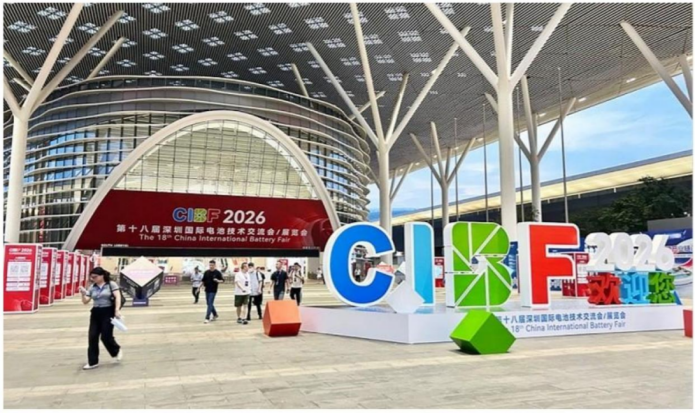
[Image] Large‑format cells become the global storage standard, officially ushering in the 6MWh era: Over‑500Ah mass‑production cells were showcased, with technical maturity and mass‑production capabilities fully verified by the industry. Traditional small cells are rapidly being phased out in large‑scale storage, while large‑capacity, low‑cost, high‑integration systems become the core development direction.
Sodium‑ion battery commercialisation inflection point officially confirmed: A 60 GWh mega‑storage order was signed on‑site (according to CATL's official Q2 2026 announcement), completely dispelling industry wait‑and‑see attitudes. The core advantages of low‑temperature adaptability and low cost have gained market recognition (HiNa Battery has already provided low‑temperature sodium storage solutions to several northern Chinese grids). The complementary lithium‑sodium industrial application pattern is now fully established (BYD Seagull and other entry‑level models have already adopted sodium‑ion systems).
Multiple ministries, including MIIT, jointly set a solid‑state battery commercialisation roadmap, officially launching a safety revolution: According to the national standard Solid‑state Batteries for Electric Vehicles (effective July 2026), the commercialisation system for semi‑solid batteries is approaching maturity. Mass‑production milestones for all‑solid‑state batteries have been set, with companies like CATL and BYD planning small‑batch installations by 2027 and large‑scale popularisation by 2030. Core technologies such as solid electrolytes and novel electrodes are gradually achieving breakthroughs, delivering a leap in battery safety performance.
Chinese companies' overseas expansion model fully upgraded: Moving beyond simple product exports, the new model integrates "technology export, joint standard setting, and overseas capacity deployment." During the exhibition, BYD Energy Storage signed a strategic cooperation agreement with Norway's Corvus Energy for maritime storage, serving as a benchmark for this new model.
5. Industrial Chain Dynamics | Industrial Chain Dynamics
1) Strategic deployments by leading enterprises
Battery manufacturers: Industry leaders continue to scale up both capacity and technology, with capacity concentration rising. CATL plans to exceed 500 GWh of total capacity by end‑2026, a 65% annual increase, simultaneously deploying three core technology routes: 587Ah large cells, sodium‑ion, and condensed batteries. In Q1 2026, its storage shipments reached 50 GWh, up 108% YoY, maintaining the top global storage market share. EVE Energy completed capacity expansion to 260 GWh, an annual increase of 150%, with 628Ah ultra‑large cells achieving mass supply. Its storage business shipments surpassed power batteries for the first time, with Q1 storage shipments of 20.38 GWh, up 61% YoY.
Materials suppliers: Midstream material companies are closely following cell technology iteration and precisely expanding production. Putailai invested RMB 5.6 billion in a 7.2 billion m² high‑end lithium battery separator project, focusing on storage and high‑end power battery markets. Enjie股份 invested RMB 4 billion in a 5 billion m² separator production line in Sichuan to match large‑cell mass production demand. Dfns (Devan Nano) invested RMB 8.7 billion in a cathode material production base in Yunnan, dedicated to supplying leading storage battery companies, ensuring downstream order fulfilment.
2) Escalating upstream resource competition
Global lithium supply‑demand remains in a tight balance, with new capacity from Australian mines and South American salt lakes falling short of expectations. On 28 May, Zimbabwe announced mandatory local shareholding requirements for critical mineral companies, raising industry concerns over upstream supply and the inability to quickly fill the demand gap caused by rapid global storage growth. China is accelerating domestic lithium resource exploration and development, raising lithium self‑sufficiency to 40%. Leading companies such as Tianqi Lithium and Ganfeng Lithium continue to deploy high‑quality mineral resources both domestically and internationally, improving supply chain resilience.
Lithium carbonate prices have been extremely volatile since 2026, with the maximum year‑to‑date increase exceeding 230%. As of 29 May, the LC09 futures contract price remained above RMB 180,000/tonne. Such sharp raw material price swings pose significant challenges to procurement and cost control. Beyond lithium, competition for core battery materials and strategic metals has intensified, with increased scrutiny of overseas Chinese‑funded mining projects, forcing domestic industry to accelerate independent R&D and production of upstream materials and core metals, improving local supply chains and reducing external risks.
3) Regulation of recycling policies
The domestic power battery recycling industry has entered a phase of standardised development. The new battery recycling management measures have been fully implemented, with the EPR system strictly enforced, clarifying battery manufacturers' primary responsibilities throughout the entire process of waste battery recycling, cascade utilisation, and regeneration. Special subsidy policies have been introduced, effectively regulating the flow, dismantling, and recycling market order for used batteries.
International green compliance standards are tightening. The EU Battery Regulation mandates that by 2030, at least 12% of battery products must come from recycled materials. With CBAM carbon tariffs now in full effect, full‑lifecycle carbon emissions and recycled material usage are officially incorporated into international trade assessment systems. At the market level, a dual pattern of "leading enterprises building their own recycling chains + third‑party specialised dismantling" has formed. CATL, BYD, and other leaders have built their own recycling value chains to create closed‑loop ecosystems. Third‑party recyclers such as GEM and Tianqi have upgraded core technologies like AI‑driven dismantling and hydrometallurgy, significantly improving recovery efficiency and resource utilisation. In May 2026, orders for recycling companies grew 50% YoY, and the CIBF exhibition showcased a new generation of recycling technologies and equipment, promoting the scaling, standardisation, and green development of the battery recycling industry.
6. Segment Highlights | Segment Highlights
Beyond the mainstream tracks, several niche segments also showed new bright spots that were not elaborated in the earlier macro analysis:
1) Residential storage
Product iteration and competitive landscape: In this booming segment, product upgrades are accelerating. 400V+ high‑voltage integrated storage products have become mainstream, with 5‑10kWh capacity and over 6,000‑cycle long life being most favoured. The penetration rate of integrated PV‑storage home systems is rising rapidly. Shipments of matching PV inverters grew over 50% MoM, and domestic equipment, with its high cost‑performance and adaptability, is capturing the global market, holding over 60% share. The competitive landscape is dynamically optimising, with leaders alternating at the top and second‑tier players accelerating breakthroughs, maintaining strong market vitality.
2) AI data centre (AIDC) computing storage
A high‑growth, high‑margin new blue ocean: The rapid development of the AI industry drives rigid demand for data centre storage, making computing storage a new high‑value incremental segment. The industry generally adopts a 1:1 storage‑to‑compute ratio, with single‑unit storage power reaching the megawatt level. This segment has high technical barriers, requiring high safety, operational stability, and an ultra‑long service life of over 15 years. Currently, LFP batteries are the core application, with sodium‑ion gradually entering the market due to its low cost and high safety. AIDC storage projects boast an IRR exceeding 15%, significantly higher than traditional storage, and leading companies are racing to seize first‑mover advantages.
3) Sodium‑ion batteries
Dual‑driven application deployment: Commercialisation of sodium‑ion batteries is accelerating across all fronts. In the storage sector, sodium‑ion production costs are 10%‑15% lower than LFP, with excellent low‑temperature performance, making them suitable for storage projects in northern China and severe cold regions overseas. In low‑speed power, they are comprehensively replacing lead‑acid and some lithium batteries, widely used in electric forklifts, AGVs, and low‑speed EVs, with costs continuing to drop below RMB 0.3/Wh. With mega‑orders and continued cost optimisation, sodium‑ion has officially entered a new phase of large‑scale commercialisation.
4) Long‑duration storage
Value realisation with policy support: Long‑duration storage has become a core support for grid peak‑shaving and renewable integration. Supported by national new‑energy policy preferences and stable market‑based revenue mechanisms, project IRRs remain steady, and investment enthusiasm is high. Flow batteries and sodium‑ion batteries, with their advantages of long discharge duration, high safety, and long life, are accelerating the replacement of traditional short‑duration lithium storage. In 2026, long‑duration storage installations are expected to grow 80% YoY, effectively addressing the volatility and intermittency of renewable generation and supporting the construction of new power systems.
5) eVTOL high‑rate batteries
Breakthrough in high‑end aviation scenarios: The electric aviation industry is steadily commercialising. In 2026, global eVTOL aircraft deliveries are expected to reach 5,000 units, corresponding to a high‑rate battery demand of 5 GWh, with leading Chinese battery companies already achieving mass supply. The aviation scenario imposes stringent performance requirements: energy density above 250 Wh/kg, ultra‑high discharge rates of 10C, and top‑tier safety levels. Cylindrical cells, with their excellent rate capability and safety, account for over 86% of the market.
7. Risks and Challenges | Risks and Challenges
1) Sharp lithium price volatility intensifies cost control pressure
Since 2026, lithium carbonate prices have skyrocketed from RMB 70,000/tonne to RMB 200,000/tonne, a cumulative increase of over 230%. This drastic fluctuation has placed enormous cost pressure on the entire industry chain. Rising raw material costs directly increase cell production costs by approximately RMB 0.06/Wh, which passes through to the terminal storage market, pushing EPC construction prices to RMB 0.97/Wh. Some low‑margin storage projects have been forced to suspend tendering and construction due to compressed profitability. Battery companies' gross margins remain under pressure, with leading companies' storage battery gross margins showing noticeable declines, significantly affecting industry profit stability.
2) Structural overcapacity and renewed risk of low‑price competition
Both leading and smaller players are expanding capacity in a concentrated manner, with capacity release outpacing market demand growth, exacerbating the risk of overcapacity. Estimates show that by the end of 2026, domestic storage cell capacity will reach 600 GWh, while effective annual market demand is only 300 GWh, leading to severe overall capacity utilisation, with SME production lines operating below 60%. To offload inventory and gain market share, some SMEs have begun low‑cost dumping, with some cell quotes falling below RMB 0.38/Wh, reigniting low‑price involution. Meanwhile, a pronounced structural contradiction exists: 500Ah+ large cells are in short supply and tight, while traditional small cells are severely overcapacity, highlighting the need for industrial structure optimisation.
3) Frequent energy storage safety incidents tighten industry regulation
In May 2026, multiple thermal runaway fires occurred at large storage stations in several regions of China, drawing significant industry attention to safety. Regulatory authorities have comprehensively upgraded standards across the entire project lifecycle—approval, construction, acceptance, and operation—substantially extending project approval cycles. To meet the latest safety regulations, companies must invest in additional fire protection retrofits, thermal runaway monitoring, temperature control, and other equipment, increasing safety retrofit costs by 5%‑10%. SMEs with weak technology, inadequate safety systems, and limited financial strength find it difficult to comply with the new rules, accelerating their exit from the market, and raising the industry's safety entry barriers.
8. Outlook | Outlook
1) Continued high market demand, industry scale hits new records
Latest research shows that June lithium industry production scheduling is expected to grow over 15% month‑on‑month, with July projected to continue growing over 10%, sustaining the high‑prosperity trend. Q3‑Q4 2026 is the peak season for centralised tendering and grid‑connection of storage projects, with domestic new storage tenders expected to exceed 200 GWh. Annual storage cell shipments are likely to approach 800 GWh, driven by both domestic and overseas demand, further expanding industry scale.
2) Product prices gradually stabilise, cost decline channel opens
As lithium mine capacity is orderly released and market supply‑demand rebalances, lithium carbonate prices will stabilise in the reasonable range of RMB 150,000‑180,000/tonne, with storage cell prices maintained at RMB 0.40‑0.45/Wh. Combined with the mass production of 500Ah+ large cells and improved yields, overall production costs will steadily decline, enhancing corporate earnings stability.
3) Cutting‑edge technologies land intensively, industrial iteration accelerates
500Ah+ ultra‑large cells achieve large‑scale market supply; sodium‑ion batteries officially enter mass production and commercialisation in Q4; semi‑solid batteries are widely deployed in storage projects; all‑solid‑state batteries begin small‑batch commercial deliveries. The technology dividend will continue to be released, driving industrial upgrades.
4) Industry concentration continues to rise, competition dimensions upgrade
The CR5 market share is expected to increase to 70%, while technologically lagging and inefficient second‑ and third‑tier companies will be accelerated out. The industry will completely move beyond pure price competition towards multi‑dimensional competition in technology R&D, cost control, delivery capability, safety quality, and global layout.
5) Industry risks gradually hedged, development resilience strengthened
Increased domestic lithium self‑sufficiency and large‑scale substitution by sodium‑ion batteries effectively hedge against lithium price volatility. Capacity regulation and optimisation, diversified overseas expansion models, and continuous safety technology upgrades will gradually mitigate pressures from overcapacity, trade barriers, and safety management, consolidating the industry's long‑term stable development foundation.
Voltrix Industry Research Centre
Hainan Moyin New Energy Technology Co., Ltd.
30 May 2026 (Released)
Data sources: Official corporate announcements, Xinlu Information, UBS International, Guosen Securities, CITIC Futures, Energy Storage Survey, My Battery Network, Intercontinental Battery Circle, Starting Lithium Battery, HUST Energy Researcher, New Materials Industry Reports, Industrial Economy Vision, In‑depth Energy Storage Observation, Huachu Network, and Voltrix internal technical research.